

By L. Luria
From November 2023, Yemen’s Houthi forces targeted commercial shipping through the Bab el-Mandeb Strait and Red Sea. The US Defense Intelligence Agency reported a 90% decrease in container shipping through the Red Sea between December 2023 and February 2024; Container hiring costs for UK exporters rose by 300% by February 2024; Suez Canal transits fell from 2,068 in November 2023 to approximately 877 by October 2024; Rerouting via the Cape of Good Hope added 11,000 nautical miles, ten days of transit time, and approximately $1 million in fuel costs per voyage to affected routes.
For three years, an insurgent non-state actor operating from one of the world’s most embittered, impoverished, economically backwards countries has decisively leveraged positional control of a maritime chokepoint, provoking disruptions to world commodity flows worth multiple trillions of dollars. Such disruption in and around the Persian Gulf demonstrates that oil as a stable foundational collateral asset may now cease to be registered according to formerly predictable financial cycles; as we have previously argued, credit, rather than profit, serves as the dominant allocative signal in the contemporary mode of production, with creditworthiness assessments ultimately dependent on relatively stable supply chain continuity. That an insurgent force has demonstrated capacity to engender sustained destabilisation of the administered credit system, in a roundabout way the essential reality of the labour performed by logistics workers, to whom we would assert hold the mandate of being the actual productive working-class in the epoch of administered credit, is ever more clearly demonstrated. However, this demonstration remains concealed, that the three-year long campaign of direct world economic sabotage has not been performed by logistics workers themselves.
This isn’t to say there’s much in the way of intuitive solidarity between a logistics worker in Britain and a Houthi militant in the Red Sea; as productive workers (in the classical Marxist sense as sellers of labour-power for a wage) and at the same time beneficiaries of the social wealth afforded by the stable functioning of the global supply chain, the British logistics worker finds themselves in a position which necessarily precludes any immediate identification with the Houthis. The phenomenon of workers holding on to more than just a baseline ‘proletarian’ existence has been a consistent feature of capitalist development for well over a century;1 In only very few and fleeting instances in the history of industrial modernity has there been anything in the way of a ‘pure’ working-class with absolutely nothing else to sell but their labour-power. The real accomplishments of the labour movement historically have led to the incubation amongst the working-class of their ‘other existence’ as citizens, reliant on the stable and continuous functioning of the global supply chain as a guarantee of the reproduction of a general baseline quality of life and purchasing power. The Houthis are ultimately too distinct in terms of social vantage and moral commitment, being themselves disinterested in the kinds of appeals to international solidarity of the type the logistics worker might be accustomed to from the inheritance of the socialist tradition. Even to identify in the Houthis something which holds a pertinence to class struggle, rather than abstract Islamic terrorism or piracy, arises only by dint of a very particular analytic vector.
With regard to labour leadership, public or private sympathy for the Houthis and the broader Axis of Resistance comes less so from an inherent social affinity, nor necessarily by an appreciation for their capacity for world-historic economic disruption, but more so owing to an inherited commitment to the inherited forms of anti-imperialism and solidarity with the oppressed – emergent trends necessitating a distance from the actual activity of these agents. Despite arising from the historical development of Marxist and labour politics, these supplementary conceptual frameworks have, over the last half-a-century-or-so, decoupled, taken on autonomous existences wherein adherents can decide by themselves whether or not to pay a historical debt to their labour movement authors. Even when an organised labourer with a good class-struggle Marxist pedigree engages with or forwards arguments pertaining to these inherited forms, a distinction necessarily persists between the local activities of the working-class and the global activities of the militant-oppressed. Attempts to forge identity between these are, again, products of a particular orientation, requiring the adoption of various assumptions which don’t necessarily register from the actual experience of the political and economic activity of logistics labour.
In kind, geopolitical thinking in the labour movement tends to distinguish between the activities of the proximate working-class and the worldwide great power conflicts, wherein domestic class struggle appears merely to interface with, being subject to / an instance in the larger machinations of competing claimant-hegemonies. In Britain, North America, and western Europe you can more-or-less group the geopolitical thoughts typical to the labour movement into three broad and occasionally overlapping tendencies, each with varying degrees of authority or ideological sway in the movement: the first we can call a derivation of Trotskyism, the second a derivation of Marxism-Leninism, and the third, for our purposes as Marxists in Britain, we'll call a derivation of Bevinism.
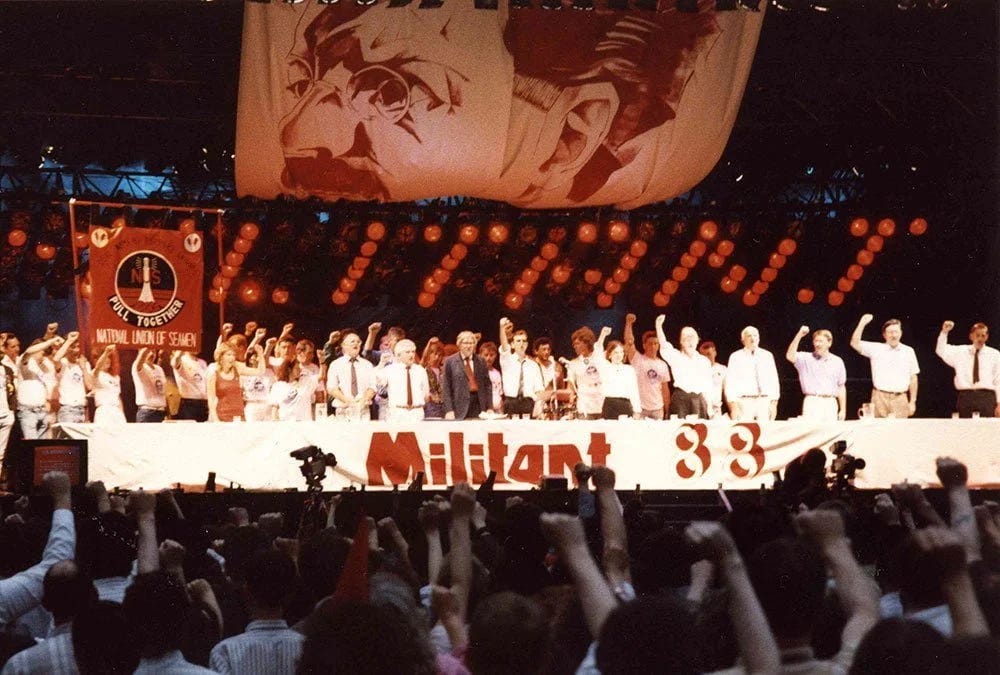
The Trotskyist derivation is, broadly speaking, a filtration of Trotsky’s commitment to a unified international revolutionary process through the vector of Immanuel Wallerstein’s world-systems framework, a methodological posture which informed a significant part of American, and later British, new-left thinking on geopolitics. The American Trotskyite Sam Marcy and his Workers World Party were decisive in this synthesis, a point to which the ACP’s Haz Al-Din – a stalwart of the second tendency – offers a practical summarisation:
“Sam Marcy did something that was rather interesting: he applied Trotskyism to World Systems Theory. It was all about the Global South, it was all about the Third World, it was all about the lowest, most oppressed nations in the entire world as the vehicle for the victory of international socialism… But later that evolves, it becomes interpreted as [something akin to Mao’s] Third Worldism… where Trotskyists are skeptical of nationalism, but if it's just the most oppressed nations that are patriotic and nationalistic, that's okay. We can forgive them for it, because they will help facilitate the actual destruction of all patriotism in general, because theirs is only based on the extent of their inequality with oppressor nations. So if you remove that oppression, we get the Trotskyite global revolution, basically.”
Trotsky's Transitional Programme (1938) and the Comintern’s Second Congress debates on national liberation (1920) lay the ground for this conception of an international revolutionary process in which oppressed nations have a specific, contingent position and a decisive role in the dissolution of the imperialist world-system. Marcy and his inheritors then extended this into a framework determined by an abstract system of increments, wherein the political content of a given struggle is determined by its position within a scale of quanta of oppression/exploitation rather than any relation to capacity for economic-military sovereignty or counter-hegemonic interdependence. The British inheritors of this synthesis – SWP, RCG, RCP, SPEW, and so on – reproduce this schematic in their postures towards Cuba, Iran, Venezuela, Palestine, and formerly Libya, Iraq, and Syria. The defining characteristic of the tendency is an affinity with oppressed nations that is indifferent to, or actively suspicious of, the counter-hegemonic capacity for non-Western states to project power, to act as an inter-sovereign economic-military bloc.
In contrast, the second tendency formulates its antagonism to the Euro-Atlantic global order by explicit recourse to that capacity which engenders suspicion from the Trotskyites, for constructing alternative strongholds of power, contesting the present hegemon on the level of geopolitical-economy itself. Haz continues:
“… Marxism-Leninism as applied to World Systems Theory …[would be the] project for cultivating and developing alternative strongholds of an alternative global system, rather than principally just focusing on the disadvantaged status of Third World countries or Global South countries. A strong emphasis is placed on an alternative global system, an alternative developmental paradigm… Russia is a big, strong country. Russia is not a Global South country. And yet Russia is at the [forefront] of anti-imperialism on the political level globally. So that's… the Marxist-Leninist perspective, in contrast to the Trotskyite perspective. It's not to say Marxist-Leninists have anything against Global South countries, especially ones that are fighting for their emancipation and liberation.”
In Britain this tendency is represented with reasonable density in the productive sections of the labour movement through ML groups like the CPB, and is observable also in the orientations of non-party and minor-party MLs in positions of trade union authority. The tendency shares with the Trotskyist derivation a formal commitment to anti-imperialism, but the substantive content of that commitment is radically opposed. Where the Trotskyite derivation identifies anti-imperialism with the oppressed nation regardless of its relation to any counter-hegemonic capacity, the ML derivation identifies it with the counter-hegemonic bloc itself regardless of its nominal oppressed-nation status. The tension between these tendencies is starkly visible in the Ukraine question: Ukraine is at the same time an ‘oppressed nation’ and also an ‘agent of western imperialism’, bringing to light the fundamental opposition that hides beneath the superficial equivalence of organised labour’s two principle ‘anti-imperialist’ geopolitical orientations.
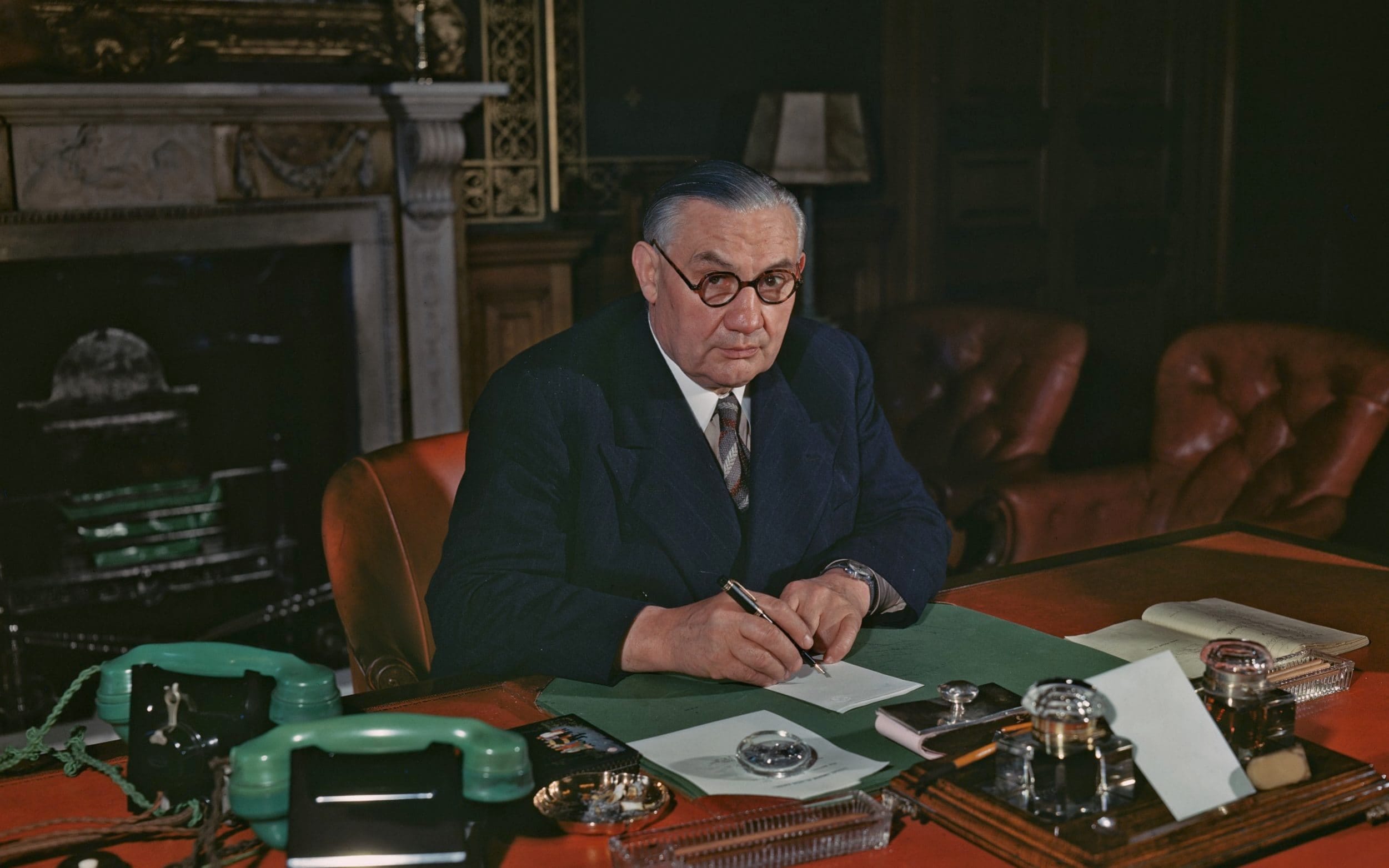
The third tendency we call Bevinist after Ernest Bevin, General Secretary of the Transport and General Workers’ Union (T&G) from 1922 to 1940, Minister of Labour in Churchill’s wartime coalition, and Foreign Secretary under Attlee from 1945 to 1951. In securing British acceptance of the Marshall Plan, the formation of NATO, and the domestic containment of Communist influence in the T&G was grounded in an analysis of working-class interest as coextensive with the stability of the post-war settlement. This is the template that the Bevinist derivation has reproduced, in attenuated form, through every subsequent phase of British labour politics. It correlates structurally with the AFL-CIO tradition through figures like George Meany, and in France a partial equivalent is found in the traditions of the CFTC / CFDT.
What we’re calling the Bevinist derivation is rather straightforward, being the formal expression of an intuitive patriotic sense and bond of solidarity which extends beyond the class to the broader structures of society and to the existing global entanglements which serve to reproduce at scale the present dynamic of class relations, with the function of organised labour being to incrementally raise the employee position within this arrangement. By extending its commitment to stabilising the class relation into an affirmation of preestablished geopolitical associations, adherents to this tendency endorse in some or another manner the solidarity between organised labour and the institutions of the British state. They tend not to extend past the horizon of a conservative conception of the working-class in their relationship to capital and the state, rather opting for a classically reformist orientation in politics, to the constraining of capital, and to the maintenance/restoration of the working-class, usually expressed today as a desire for the Government to pursue a more pronounced industrial strategy underwritten by rearmament. Of the three tendencies, Bevinism speaks most profoundly to the given reality of the worker-as-citizen, beneficiary of the stable functioning of the global supply chain, rather than to the ashamed repression or conceptual dismissal to which the ‘citizen’ aspect of the worker’s character is subjected to.2
The Bevinist and the Marxist-Leninist tendencies, being reflections in domestic labour politics of an actual contestation between two conflicting power-blocs, makes them ciphers for actually opposing systems of economic development. The Marxist-Leninist analysis of the Sino-Russian bloc is substantively coherent in ways that the Trotskyist quanta-of-oppression schema isn’t, and the Bevinist attention to the material content of the worker-citizen compact is coherent and self-justifying in ways that neither anti-imperialist tendency are capable of giving sense to or absorbing the category as a positive feature of their systems. However, a basic synthesis of some form of ‘Bevinism-Leninism’ which retains the worker-citizen while at the same time pursues the breakdown of all guarantees of the reproduction of this form, would be paradoxical. The solution to the shortcomings of all the named tendencies requires a more profound operation than mere arbitrary syncretism.
Despite an inheritance in class struggle politics and the conceptual developments thereof, all the named tendencies reproduce commitments partially extraneous to the subjectivity of labour as such, both in its specific local determination – conflicted as it is between worker/citizen – and in its universal, general reality. They refer instead to certain steps along the road of class struggle’s maturation through the 20th Century, steps whose resultant conceptual products have to a large extent become estranged from their originary relation to the working-class in as much as the products of labour of varying forms under capitalist relations of production produce objects which stand apart from and against the worker. Recognising this conceptual estrangement then necessitates levelling scrutiny on the premises of each towards the working-out of something we can properly call a working-class geopolitics, a self-directed orientation which doesn’t rely on secondary political derivations, claims, and assumptions, instead re-grounding what is useful from the tradition in-total by a concrete interrogation of the present qualitative historical determination. Such a comprehension of geopolitics would have to speak to the double determination of the worker-citizen, but in a manner which doesn't necessarily collapse one into the other, engage in meek repression, or ignore the actual material advancements achieved by the development of the economy and of the labour movement’s inseparable part therein.
Is it right to say that the working-class ought to act on behalf of the world’s oppressed, the counter-hegemony, or the nation? Do any of these have an essential bearing on the working-class in its aspirational and self-consciously particular form as a class-for-itself? The question therefore becomes: could a working-class geopolitics in some way speak less to how organised labour interfaces with the world conflict before it and above it, which side to take, etc., but instead how labour might conceive of itself as itself, as a sovereign power, a force which knows and exercises its own partial interest, claims its own ‘territory’, asserts its own discrete will, etc.?
Note: due to Substack's email length limits, this post is in two halves. The second half will be posted shortly after this one, and should be available to read now.
When the Bolsheviks seized Russia and established Soviet power, they anticipated the industrial working-class to have joined their ranks by no other choice than material circumstance, with civil war promptly dashing these illusions; as the violence mounted, droves of workers upped sticks and returned to meager land holdings in the Russian interior, thus evading much of the excesses of the civil war, and were ‘suddenly’ converted from proletarians into peasants.
A fourth formation, which does not originate in the labour movement but which shares structural features with the Trotskyist derivation, warrants brief attention; Islamism in Britain has, for much of the 21st Century so far, held broad affinity with the left wing of the labour movement in their geopolitical postures, with Iraq in 2003 and Gaza in 2023 as decisive points of unity for their respective periods of agitation. Where this unity breaks down is most clear on the Syria question and the China question, where they and the left (at least, broad sections thereof) diverge significantly. Alliances built around one geopolitical point of agreement wil end up breaking down on another. These kinds of ruptures are near-inevitable, and left wing investment in unifying Islamic and labour interests typically make rather scant returns in the long run (cf. Respect, the Workers Party, Your Party, etc.)