


It’s been some time since our last post. Readers familiar with our output, specifically posts between the 9th of June and the 6th of July 2026, may have gleaned that certain conclusions we arrived at had made it difficult to proceed. These conclusions, combined with the private thoughts and conversations between myself and my erstwhile collaborator S.E.P., have led to us going our separate ways (for now). There is no acrimony between us. In fact, in the months between July and now, I had more or less agreed with his basic outlook and have found it difficult to write out my own prognosis on the problems we had arrived at. In brief, I believe that we were maybe ‘too correct’ for our own good, that we had driven Marxism to a place where it couldn’t properly recover. Oh well, I thought; such is life.
I have been a consistent Marxist for some ten or more years now, with a few brief blips along the way, sojourns into some idiosyncratic and romantic furrows for which I have since repented. I forget where this critique is first levelled, but I remember reading about the strangeness which befell the official Marxism of men like Eric Hobsbawm during the period of liquidation, the late 1980s and onwards – not a theoretical strangeness, as with the later Althusser, but a strangeness with regards to ‘official’ Marxism’s position relative to other tendencies. In their antagonism to men of the new left, Perry Anderson and the like, there was (before liquidation) a certain intellectual security afforded to the ‘official’ Marxist by the persistence of ‘the Party’ (at the immediate level) and of Moscow (as a universal referent). This security is perhaps equivalent to what the first and second Temples were for the Jews. A tremendous anxiety prevails in the absence of ‘the Party’ and of ‘official lines’, a circumstance that renders all Marxist work effectively ‘equal’ – equally bad, equally good…
Despite the desires of some, Beijing is not our Moscow. A Communist can emulate the Chinese line but they won’t in turn receive recognition. China’s formal acceptance of a few legacy Parties here and there serves in real terms as a back-channel between Beijing and western governments. The ‘local’ Communist Party has been purified of historic responsibility, of any sovereign function. At the outset of our project we more or less renounced the concept of ‘the Party’, not in the sense that we were (as the Stalinists say) ‘Anti-Party’, but that we saw that there was no Party, meaning the thing which gave Communists recognition, security, money, and so on. In kind, there can be no ‘anti-Party’ Marxism either.
Rather than proposing a Party (as many still do), we came in our last outing to propose a form of organisation we called a ‘school of Subjects’ cohering around the fatal conclusion that our own local proletariat had been materially reconstituted as a minority of roughly 8% or less of the British labour-force. In the last post I wrote that Subjectivity “cannot arrive as a by-product of the economic given reality”, that “where it exists at all, it does so as deliberate discipline, from the cultivation of one’s conscious critical distance”. Here it is maintained that Subjectivity properly conceived is always possible, yet it will elude the aspirant so long as they carry on as “a mere individual – in other words, so long as they remain ‘non-political’ in a concrete sense.” This is the paradox of our period, that to be properly human and ‘individual’ you must be properly political, yet one must also be ‘truthful’ in circumstances where the truth compels you to know politics in its present form: stultifyingly indeterminate, useless, without historical content, and so on.
The above was owed to a broader diagnosis that contemporary socialist organisations, living in ignorance of the proletarian minority, maintain an inherited ‘mass’ idea of the proletariat which we understood as being a coalition of indeterminate labour-power sellers dwelling in conditions of virtual unemployment, their capacity to meaningfully withdraw labour objectively annulled.
The appearance of contemporary class politics in our period is, as I saw it, “defined by the injunction to ‘feel’ for the class rather than belong to it, or act for it, directly.” The only error in my treatment of this fact is that I forgot to say that I don’t begrudge this. My counter-proposal at the time was effectively the same thing, only that I proposed to proceed without lying: The basic characteristic of political organisation is antagonism, which may then be emancipated from the fetters of inheritance and redundant form, and from there we might pursue a “political organisation conceived as the institution for the cultivation of subjectivity” wherein “its internal life” of “study, discipline, formation, the levelling of demands, the drafting of theory” would be exalted as an end rather than a means.
All this is to say that we are starting anew, as you may have already guessed, while maintaining more or less the same basic premises. This detail about the ‘school of Subjects’ has led me to reconceive the project altogether. My former collaborator is, as of now, no longer an intimate part of this, so I have arranged for replacements. We are now three, rather than two, and shall proceed from here. Apologies for the delay.
* * *
For those who still commit to the British Union in some way or another, it is clear that Monarchy is no longer recognised as its sole legitimate binding instrument. To cohere a politics adequate to this fact, one could either defend this institution and its myth, grant legitimacy to it through a Royalist politics which would inevitably be a contemporary project designed to wear the edifice of tradition better than what wears it now, or one could soberly confront the impracticality of the Monarchical edifice as a whole and advocate something else. Bagehot famously wrote of Monarchy: “We must not let in daylight upon magic”. This has become the faux-occult motto of Royalism. You will hear it said around Old Queen Street or Tufton Street, the favoured quip of Tories and Post-Liberals. Being reasonable people, opposed as we are to darkness and witchcraft, we have no choice but to pledge ourselves to the cause against Monarchy and expound on certain facts which draw the necessity for a Republican politics at this critical juncture into view.
It seems quite certain that Great Britain is on the threshold of a momentous constitutional transformation. Discounting England, nationalist movements now hold governmental office or its equivalent in each of the British nations, with the SNP in a fifth term, Plaid Cymru leading Wales for the first time, and Sinn Féin holding the First Minister’s office in Belfast, alongside a nominally socialist president in the Áras sympathetic to the cause of a 32-county Irish Republic. Discourse concerning nationalism and separatism typically aligns in the London press with the apparent phenomenon of ‘left-populism’, that increased support for nationalist movements occurred, during the Starmer period, in circumstances of a cataclysmic drop in support for the Labour government coinciding with a leftward turn in the Green Party. This all persisted against the backdrop of Farage’s seemingly unstoppable march to power, the threat of which gave reason for the nationalist parties to agitate and cohere. The great paradox of Reform’s Unionism in the period just gone is that the better they did, the higher the upswing of separatist support. In each country’s instance, the leading nationalist party has substituted parts of their constitutional programme with social-democratic policies ‘left out’ from Starmer’s formulation of Labour politics – food price caps, rent controls, and so on. Before summer 2026, these circumstances enframed constitutional discourse in the British nations.
The standard Marxist answer for this, at the time, was that the national question was being contested in a roundabout way as a displaced class question. There is some justification for this, at least from the standpoint of received Marxism, owing to the fact that the electorates which returned nationalists in post-industrial Scotland, the Welsh Valleys, working-class West Belfast, and so on, are evidently responding in much the same way as Reform voters have in the old ‘Labour heartlands’ of England, indicating a common factor preceding each party’s formal ideological postures. In any case, one ought to concede that these forces represent in some way a meaningful articulation of the general dissatisfaction which the mainstream political parties in Britain had so far been incapable of responding to. This was a relatively certain diagnosis before Andy Burnham became Prime Minister, with Labour no longer playing the kind of antagonist against which Reform and the various nationalist projects can define themselves (at least, not in the manner we became accustomed to from July 2024 to July 2026).

For the nationalists, the United Kingdom (centred in London) had served for their rhetorical ends as a locus of resentment, playing the enemy in a framework which absorbed and articulated a diverse host of maladies in a politically intelligible way, certainly more-so than the old socialist-derived project was capable of. The perversity of our period is that now the Labour Party seems to have assumed an equivalent posture to the nationalisms through the wager of ‘Manchesterism’. What all of these tendencies have in common is that political economy is considered secondary to the symbolic potency of carving a base of sovereignty out of London’s control. For better or worse, the enemy ‘London’ is the discursive pyramidia of contemporary British politics, with immiseration in the sphere of social reproduction finding soft footing in the yearning for ‘authenticity’ and ‘community’ to be located outside of the capital. All tendencies currently at play in British politics seek to enter a battered, superfluous subject back into the circuit of political acculturation without recourse to how they might locate itself within the wider economic arrangement except as refuse, the ‘left-behind’. Desire for exit, articulated in anti-London sentiment, is the recoiling in horror at the malaise of our social-reproductive crisis, the response of a people whose forebears were once capable of assuming an optimistic character through social mobility or revolutionary desire. Those who make up this type of subject, as our economic downturn has proceeded to free-fall, all exits welded shut, assume the determination of a civic nihilism, of an aimless thrashing antipathy. History and societal mission play no role in this politics.
This sentiment has then stratified into distinct forms determined at the national or regional level by variations in social inheritance, lending the appearance of inter-fractional opposition to what is, by any reasonable account, the same objective movement and the same basic phenomenon, regardless of its specific articulation. In England, the yearning can be neatly articulated against immigration; in Scotland, Ireland and Wales, against the English. For ‘Manchesterism’, against London. ‘Secession’ has assumed an undeniably ascendant position on our left, so much so that George Galloway (who only very recently led a multi-tendency pro-Unionist campaign for the Scottish Parliament) has declared his programmatic divorce from Unionism. Burnham’s mobilisation of anti-London resentment on the one hand, Galloway’s about-turn to nationalism on the other, are proof enough that a familiar Unionist left-wing is dead.
The national question has historically been harder to ask in Britain than among our European neighbours, owing to the peculiar path which we’ve taken towards modernity. By the letter, the United Kingdom isn’t a ‘proper’ nation-state, at least in terms of genealogy, having never ‘needed’ to undergo an explicitly bourgeois-democratic revolution, nor the drafting of a formal constitution, nor the other trappings which tend to define modern polities. The United Kingdom is, constitutionally, a union of disparate aristocratic holdings under a single Crown, a feudal superstructure wrapped about a modern base, blearily stumbling through history to find its ‘seat at the table’ among the nations. That Britain arrived at modernity before any other nation is, of course, a strange irony.
Communism and Fascism never took hold here as they did on the continent, nor is trade union affiliation explicitly political or religious as it is for most Europeans. No matter how similar the circumstances between us and them, half of Europe has seen unrest this autumn, whereas Britain has not. Not long ago only cranks felt it necessary to worry about the anachronism of our particular political form, about our ‘quaint’ domestic political settlement and its formal inconsistencies. Today, however, the national question is posed more often, more forcefully, more decisively than at any prior period, though characteristically it is posed through the familiar vector of the talking shop, the Union’s subsumption of seemingly antagonistic nationalisms arising as mere business on the order paper for national and devolved legislative bodies. Perhaps this is how it has to go – can a state which never formalised its own foundation only be unmade informally, through the gradual withdrawal of consent? Will the King simply evaporate?
Britain’s peculiar process of historical realisation provokes in Marxists the view that the Union is somehow arrested in its political development, dragging undigested feudal matter through three and a half centuries of economic development. Yet, as our comrade Vince Garton has argued, though our seventeenth-century settlement failed to give way to a ‘modern’ nation-state, it did lead in time to the development of the British Empire, a form far more suited than any other to nurturing the incubation of the capitalist world system. While written constitutions are firm, Apollonian documents, affording a degree of partial constraint to the explosive potentialities of capital, our ‘ancient’, murky, boozy non-constitution granted to the Empire a capacity (at the level of the law) to maintain moral political continuity and, as a result, political consent for the apocalyptic acceleration of the modern regime of accumulation and the development of the forces of production, for blowing apart every vestige of tradition at the discrete, socially proximate level, all the while elevating formal traditionalism – that which dwells in the embrace of Imperial Monarchy – to engender the normative model for a global capitalist order, successfully organising and managing the world for two or more centuries.
As Vince said to me in our conversation from a year or so ago: “The initial postcolonial order, which was the high tide of the welfare state, was in place for a few decades until Thatcher, and even more importantly New Labour, which brought in a kind of parodic revival of the imperial political economy. London was flung open to foreign investors and became an open market rather more like what it was in 1920 than in 1970, with the exception that now it was dominated by foreign capital making ventures in Britain rather than British capital making ventures overseas. What this means is that rather than just a vista of stagnation stretching on from 1688, we have something more time-tangled, a constant back and forth as these different tendencies – corresponding to different factions of capital and the British managerial elite – make themselves felt in their various directions. There is an unhealed wound that separates national Britain from the British Empire and holds them in contradiction.”
From this vantage, contemporary nationalist movements represent the casualties of national Britain rising against the City of London; Clydeside, the Valleys, the North East and North West of England, Belfast, etc. all formerly constituted our national-industrial foundation, subjected to the collateralisation of state assets which underwrote at the physical-economic level the ephemeral symbolic forms of Empire, Monarchy, Union, and so on. Reform UK is, in this way, indistinguishable from the nationalists, vying amidst the coalfields and estuary towns, expressing in so many words the same grievance, while Labour, in kind, assumes an equivalent posture to contend on this same terrain. This is the new settlement.
In response to the rise of Britain’s nationalisms, the Communist Party argue that because monopoly capital is organised at an all-Britain scale, the class confronting it must also retain and defend the all-Britain state as its arena of contestation. Naturally, as Leninists, they hold the right of self-determination to be unconditional, yet the actual exercise of such a right is subordinate to the ‘class question’ (to be answered in the negative wherever separation would ‘fragment the class’). This analysis presupposes continuity in the constituted British working-class subject, whereas conditions as they are necessarily lead one, following Marx’s distinction between a class in itself and a class for itself, to conclude that no such subject actually exists, that the integrated productive economy which the policy would seek to ‘federate’ has already undergone collateralisation and liquidation by forces which no national or devolved power may ever seek to contend with. If we maintain that objective division at the class level precedes all other divisions, including territorial ones, the presently existing Union doesn’t itself afford any specific capacity for the working class to act as a class-for-itself. The contiguity of the Union holds no essential bearing on the real constitution of the class, being for us a minuscule social minority who, at present, act ‘for themselves’ only within the narrow procedural boundaries of formalised, legally bracketed ‘industrial relations’ (and so do not act for themselves at all).
So if nationalism, rather than Socialism, is giving some kind of adequate expression to the underlying economic realities of Scotland, Wales, and Northern Ireland, why should Socialists desire to stop it? If Reform UK affords the same for the English hinterlands, so what? If the Union is dying, if the old form of sovereign order is increasingly proved bereft of public consent, why forestall the inevitable? Rather than vainly hoping that some new formulation of Marxist politics might, at some point, grant adequate theoretical expression to the sentiments currently expressed, surely it would be more useful to understand what people are expressing already, which formally relates to something previously articulated as revolutionary desire, and at the level of content is propelled by transformations in the forces and relations of production. Personally, I can think of nothing more exhilarating than contributing to the formation of a new country – for the nationalists in Scotland and Wales, this is a more viable prospect than it has ever been before. The allure of exit through expressly political, reconstitutive forms has never been more tangible. Now, the reality of this political reconstitution will likely be rather dull, but the prospect of it, its anticipation, is anything but.
All this is not to say that the unity of the British nations is necessarily impossible. It is not unthinkable that the breaking apart of the present Union may merely precipitate the reconstitution of an entirely new Union on firmer ground. From 1918 to 1941, the Kingdom of Yugoslavia, then under the familial domination of the Serb House of Karađorđević, suppressed the independent national strivings of the south-Slavic peoples, which were left unsatisfied before the national question was briefly ‘answered’ in the malformation of borders and the erection of comprador nationalist regimes under German and Italian occupation in the Second World War. Despite this, from the 1940s through to the 1970s, a union of the south-Slavs persisted through a new ethnogenesis born of the wartime partisan struggle, superseding the question of discrete national self-interest which had been left open in the Royalist period.
The economic downturn which began in the 1970s, followed by the death of Tito in 1980, rendered the Yugoslav project increasingly less viable, thereby giving way to the morbid nationalisms which drove its Republic to bloody catastrophe in the 1990s. While Yugoslavia’s collapse leads us to mark the project as a failure, in the brief window whereby the south-Slavic peoples enjoyed an economically productive, federally integrated, popular-republican social form, such antagonisms were successfully repressed. Of course there is a world of difference between today’s United Kingdom and historical Yugoslavia – I only mention it to demonstrate that the breakdown of one faulty system of integration and shared meaning does not necessarily preclude the emergence of another, more sufficient, more satisfactory one, born of a determinate historical unity embedded in the activities of people themselves rather than the inheritance of an artificial compact.
From here we can begin to recognise what Republicanism would mean in Britain, against the dull Parliamentarist-liberalism of the ‘#NotMyKing’ movement, the civil society organisation ‘Republic’, Clive Lewis, and so on. We can instead wager a new settlement between the nations of the British Isles which might occur at the eclipse of Monarchy, a revolutionary event granting form to a more fundamental process of reestablishing sovereignty at the social and physical-economic level. This procedure doesn’t necessitate a rerouting of pre-existing antipathies towards a new myth, as is the concept of change amongst contemporary Socialists and ‘left-populists’, but is rather the cultivation of a wholly distinct Subject not interpellated in the logic of the present state of things.
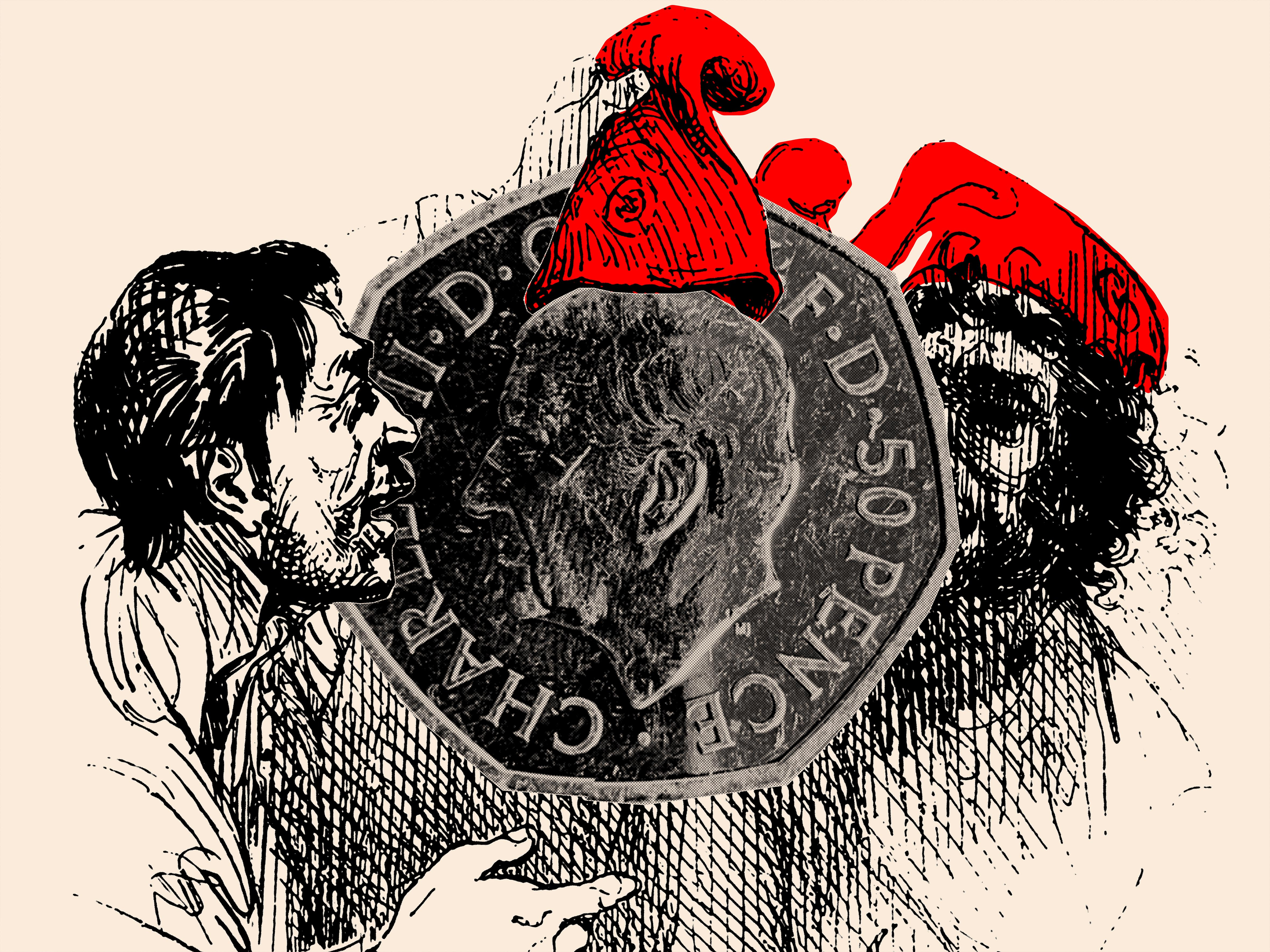
Despite Monarchy being merely formal, form is significant as the means of delivering us to the content of a thing. Therefore, the interruption or realignment of form and content is necessary evidence to note the changing of a given era. Take the example of money: for the majority of this country’s existence, a person interfaced with monarchy most of the time at the point of payment, in the transfer of coins and notes, cash historically being the cipher of sovereignty for as long as complex forms of social organisation have existed amongst human beings (in other words, the King’s head is on it). Cashlessness interrupts this procedure, is symptomatic of a more fundamental process of liquidation in the organisation of the present state of things, first and foremost as a breakdown in the phenomenal encounter with the Monarchical idea. Those who feel it imperative to use cash, the Piers Corbyns of this world, are themselves dissenters, Corbyn being a ‘lower-case-r republican’ along with his brother. Paying with cash is, for Piers Corbyn, not about paying with cash, cash being minted by the Royal Mint and imbued with value by the Bank of England, by global currency markets, by the regime of accumulation, by the petrodollar system, and so on. For men like Piers Corbyn, paying in cash is a form of resistance, in fact, to the very system which makes cash possible.
Cash, being in this period second to credit or cashless transfers, becomes a cipher against the present state of things, against the appearance of the coin or note itself. There has been a reversal immanent to the function of cash; that this is permissible is proof of a profound rupture, that to defend Monarchy is in a sense equivalent to attacking Monarchy. They are both permissible. The case for Republicanism begins from the standpoint of antagonism, of a Subject opposing an object. In that sense it is a human project: The individual who persists in using cash as a discipline is performing a perfectly human act, whereas one who happens to have some change in their pocket is performing in a wholly different way. In kind, a Royalist who ardently defends the myth and edifice of Monarchy is nearer to us than a Republican of the Clive Lewis variety (for this reason, Piers Corbyn is a better Republican than his brother, despite the latter’s work with Tony Benn in the 1991 Commonwealth of Britain Bill, if only for the seriousness with which Piers Corbyn takes the cause of cash).
There is an anecdote from the reign of Akhenaten, Pharaoh of Egypt in the middle decades of the 14th Century BC. After ridding his Kingdom of the crude idol worship of the Osiris Cult and elevating the Aten, disk-of-the-sun (formerly a constituent aspect of Ra), to assume the position of the one true God, Akhenaten invited foreign dignitaries to meet and know Egypt’s new God. At the new holy city Akhetaten, the Pharaoh’s men would lead these emissaries of foreign powers into a vast open courtyard, under the sun at noon-time; the doors would lock behind them. This was the new God, the noon-time sun, radiant and ever-giving, for whom nothing in turn is required besides experience. So goes the Great Hymn of the Aten:
When you retire unto the West, / the land is under the shadow of death / The sleepers hide in their chambers, heads in their hands; / No eye makes out a companion. / Whatever they own is up for the taking / if it were swiped from under their noses, they would not know it. / A lion hastens at every den. Every adder bites. / Darkness closes in, silence o’er the Earth - its Maker adjourns; until – / Ah, the first light! / Spilling over the Horizon, the sun-disk shining in its day! / You banish the darkness, send forth your rays, and set the Two Lands dancing! / Raise up their bodies, swaddled and pure, / Limbs outstretched for love of the Dawn.
Returning to the quote from Bagehot, that “we must not let in daylight upon magic”: Just throwing light onto something isn’t enough. Something considered ought to oppose the given – or, more precisely, consideration itself must oppose the given, the given being inert. Once a certain order has persisted for so long it becomes like nature, occluding its origin in the ‘arbitrary’ imposition of human agency into given reality, becomes part of given reality, the ever-recurring sign of the given in everyday life. This was the Jahaliyya of Mecca before Mohammed, the Cults of Amun and Osiris before Akhenaten, and the world of men before the Covenant of Abraham.
Domination by the laws of nature and the laws of tradition are identical at the level of individual experience. We know from history that both nature and tradition can be overturned, however, brought to heel under the personal and inter-personal domination of human beings. The Sun is boundless energy, which needs no recompense; Human beings, too, are capable of boundless energy, and the bowels of the earth are filled with infinite treasure. The only limits to human beings are the limits of time and space, which are warped and folded in by human activity – railway lines, motorways, telecommunication, and so on. There will nevertheless always be a certain realm of necessity, however that necessity is itself the grounds of concrete human freedom. Republican politics then begins from antagonism, from the organisation of people who desire to act rather than give themselves over to being acted upon, with the cultivation of a critical distance, which means to hold one’s conditions at arm’s length, to come up behind yourself and see and know what it is you’re doing. In other words, it means the realisation, at every conceivable level, of concrete human freedom – this begins, for us, in the immediate relation between Subject and King.
