

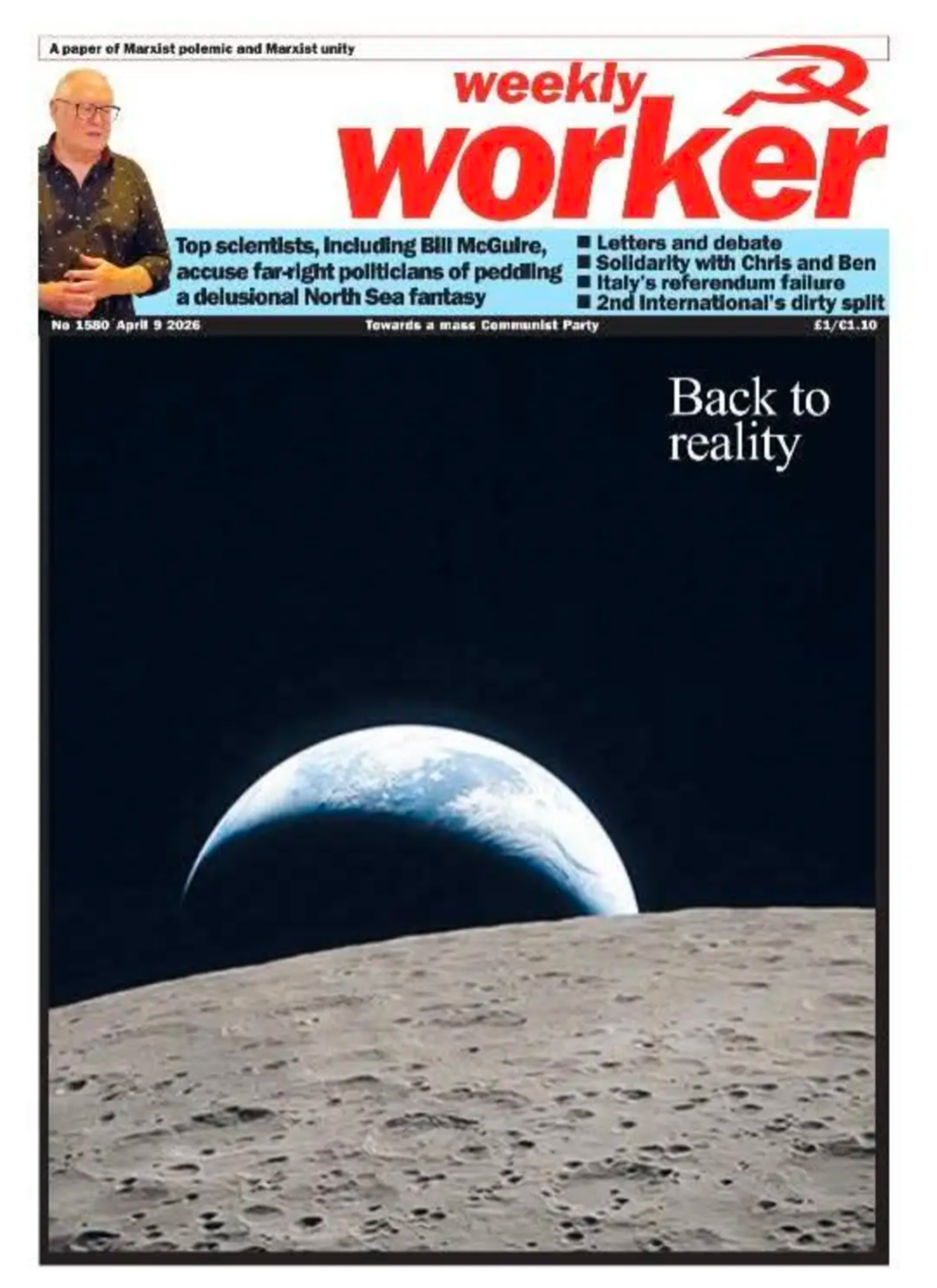
When this week’s edition of the Weekly Worker landed on my doorstep, I had for the first time in some months a sense of profound feeling for the collective body of humanity: in front of me was a full-page image of earth-set, this once-in-a-hundred-generations event witnessed by the Artemis II crew on April 6th, 2026, during their sling-shot mission around the moon. This photograph, a profound representation of the advancement of the species, the refinement of human mastery over nature, was accompanied by three words, white text set upon black void: ‘Back to reality’.
At long last, I thought, some serious engagement from a ‘proper’ Marxist journal, a vindication on the continuity of human accomplishment and progress, ‘reality’ meaning the unleashing of collective human potential, the whole of the world raising itself from the doldrums of post-Apollo mediocrity and blasting open the contradiction between the possible and the real in a limit-test of contemporary relations of production, revealing the living proof of a human future to come in a state of profoundly repressed, yet ultimately unstoppable, construction. Imagine, then, my disappointment when I turn to the article and read:
“Artemis II and the new space race do not represent a great leap in human progress, argues Paul Demarty. Instead, what we have is a criminal refusal to take responsibility for the dire conditions here on Earth” (my emphasis).
The article begins with a brief hand-wave about Artemis being a “welcome distraction” from the Iran War, which reads as if Demarty is insinuating that a space mission years in the making was actually, maybe, in part, some kind of a ploy to get people to stop caring about the US bombing Iran for maybe two days. Demarty’s apparently substantive criticisms begin with direct comparison between Artemis and Apollo meant to reveal Artemis’ profound shortcomings while also Critically Criticising the exalted status Apollo has in the popular imaginary.
Demarty states that the primary objective of Artemis is “to recapture the optimism of the Apollo programme and its successes,” going on to suggest Trump’s ego as an inciting factor, that “Trump is a man who likes to put a shiny item on his CV.” Nevermind that this statement coming less than two paragraphs after a claim that the program was only “just about tolerated by the cost-cutting Trump 2.0 regime.”
Artemis is, according to Demarty, “from a strictly scientific point of view… worthless”, a claim he attempts to back up by reference to previous research into the effects of zero-gravity on the human body, that further research is “redundant,” and so on; however its difficult to see how his very specific criteria for ‘worth’ passes inspection: the article has no reference to or engagement with the possibilities for gathering deep-space radiation exposure data, lunar surface resource assessments, speculative development of long-duration life support systems, or any of the other fruitful research benefits Artemis very obviously facilitates. Addressing Apollo, Demarty claims it was, first and foremost, a “grand-nation building project, using the cutting edge of rocketry, computer engineering and aeronautics to go, as the Star trek slogan would later have it, where no man has gone before,” followed by a pompous derision of the whole enterprise as being “very American.”
Demarty is, ostensibly, a Marxist in good standing, one that the CPGB-PCC believes adequately forwards what a good Marxist line on space exploration ought to be, so much so that it takes pride of place as the cover article on this week’s edition of their paper. That this supposedly Marxist position appears more like a relitigation of Gil Scott Heron’s Whitey On The Moon, meekly asking why public money was spent on space rather than ‘welfare’ or ‘housing’, is disappointing, especially when coming from from the otherwise rather consistent and considered Weekly Worker. When faced with projects which bind together the scientific, productive, technical, logistical, political, and geopolitical threads undergirding the totality of our present social/economic order, rather than this type of miserly welfarist ‘interrogation’, should not the question be “does this investment generate qualitative transformations in the productive forces of the entire human race?” In the case of Apollo, that “very American” “costly display”, absolutely and unreservedly did.
The Apollo 11 guidance computer (AGC) serves as the clearest demonstration of this basic point, a piece of technology Demarty affords no more than one sentence to: “The Apollo 11 guidance computer, a justly legendary technical accomplishment, would be hard-pushed to power a modern television remote, never mind a smartphone.” He is of course correct, but what he fails to mention is that had it not been for the AGC, we would not have contemporary television remotes, or smartphones, or laptops, or half of the amenities and technologies which make up the fundamental infrastructure of our present existence (this rather obvious detail might potentially be important for a Marxist if they’re serious about the economic history they’re engaging in, especially given the terms of Demarty’s argument, that an attempted repetition of the Apollo event on a higher scale “[does] not represent a great leap in human progress.”)
Less than two years into the design process for the AGC the engineers developing it realised that transistors, which had served as the basic technical infrastructure for approximately all circuitry up to that point, were materially insufficient to provide the necessary computing power to accommodate the strict parameters of the lunar mission. In order to overcome this, the relatively novel integrated circuit (chip) was used instead; the AGC thus became the model for all subsequent computers, and iterations thereon, which came after it. By 1963 Apollo was consuming 60% of total US integrated circuit production, accelerating demand, renegotiating domestic supply chains, and leading to a rise in global attention on semiconductor development, therefore to the foundation of the semiconductor industry which now undergirds humanity’s collective existence. Had it not been for the Apollo program, necessitating as it did a radical active intervention by the American state, the rapid technical improvement of integrated circuit technology (attested to directly by Apollo engineers) would have slowed down development of the technology by roughly ten years. In short, the accelerated development and standardisation of production, alongside validating the commercial viability of a hitherto relatively niche technology, all for the ends of a ‘wasteful’ leap into the void, built the actual foundations of our present reality. Demarty goes on to talk about Elon Musk later in the article: that the power and wealth of Silicon Valley is a direct, traceable result of Apollo’s pressure on the semiconductor industry in the 1960s, seems not to factor into his analysis of Elon Musk, or any of the other politically decisive billionaires whose wealth sprung from the post-Apollo tech industry.
Given the constant capital developed during the program and that Apollo's investment rose the rate of surplus value outside the existing reproduction circuit, it is beyond self-evident that “costly displays” such as Apollo are themselves a tremendous motive force for the development of the productive forces and, in their capacity to marshall the supposedly capitalist state to serve interests beyond immediate capital returns, such programs engender the partial suspension of the artifice of capitalism itself, revealing actual material possibility from beneath the inverted frame of social necessity. Through the cultivation of a qualitatively new productive sector in semiconductor manufacturing and, subsequently, the entire information-technology complex, Apollo’s contribution to a rise in the productive power of the social totality (relative to its reproductive costs across subsequent decades) demonstrates in crystal clarity the characteristic emergence of general intellect, the determination of generalised, objectified knowledge over the basic circuit of accumulation.
That the M - C - M’ circuit persists in some form or another does not negate the fact that, for Apollo, its law was overridden, subordinated to an abstract social logic unassailable by a legalistic comprehension of political economy. Operating at the absolute limit of technical-scientific possibility, the Apollo program generated such a profound forward development in the whole productive forces, engendering a diffusion of that technical knowledge throughout the entire American industrial base and, given the program's fundamental reliance on / development of global supply chains of the period, this diffusion undertook a global character, raising and developing the productive, scientific, and technical capacity of the human race in general.
Granted, Artemis is (in its present phase) not the Apollo mission, and thus occupies a far less fundamental position in our present popular imaginary. But to state Artemis is just a “faltering attempt” to recreate Apollo immediately falls apart when you look at the intended scope of Artemis, the permanent moon bases and manned trips to Mars so derided by Demarty in his article. Artemis will, if it is allowed to proceed, necessarily facilitate a fundamental acceleration of development, a rise in the productive power of the social totality which will – if allowed to progress towards its intended ambition – usher in so profound a revolution in the forces of production, confirming without question the possibility for precisely the kind of revolution in the relations of production Demarty pins his hopes on towards the end of the article.
Men like Demarty would rather see us move deckchairs, redistribute already existing money for poor people, rather than build an economic foundation upon which everyone’s living standards will be raised. Kicking the can down the road, he argues that “Perhaps, when every belly is reliably fed on our own planet and nuclear arsenals are no more than an anxious memory, we can put a few brave souls in a tin can and launch them towards the moon or Mars. It would be, for world communism, just what it is for capitalist society today - a flex, a ‘because we can’ move. Sometimes that is reason enough.” While I’m at risk of repeating myself here, that he considers one of the most profound potential transformations in the productive basis of the human race as pertaining only to symbolic value, and nothing more, is such a profoundly disappointing thing to read from a Marxist.
Demarty sums up: “Under present conditions, however, one can only deplore the waste and hubris. Artemis II is a flight from Earth, but also a flight from the capitalist world’s bad conscience.” Two minor corrections, and we’ll leave it there for now: 1) Without ‘waste and hubris’ there can be no end to ‘present conditions’; 2) The ‘flight from Earth’ is, more precisely, the flight from capitalism. Developing cislunar infrastructure, gathering deep-space radiation data necessary for subsequent crewed missions beyond Earth orbit, developing reusable heavy-lift architecture; all the supply chain reorganisations necessary to facilitate the project, all the diplomatic negotiations which would allow necessary materials trade, the energy output required, and so on and so forth… whether all of this genuinely contributes a meaningful general intellect investment is a serious debate which ought to be had, but as it stands Demarty and the Weekly Worker didn't even consider that it might be. In any case, I would go so far as to say that without Artemis and without even more money and resource pumped into space programs – disgusting amounts of money, money at the expense of welfare bills, money that could feed a city for ten or more years – that the horizon of arrival at a higher form of civilisation becomes increasingly distant. In that case it’s infinitely more barbaric to raise someone’s dole allowance by 15%, build a few shoebox council flats, all the while consigning the human race to another century of mediocrity, hunger, and death.