

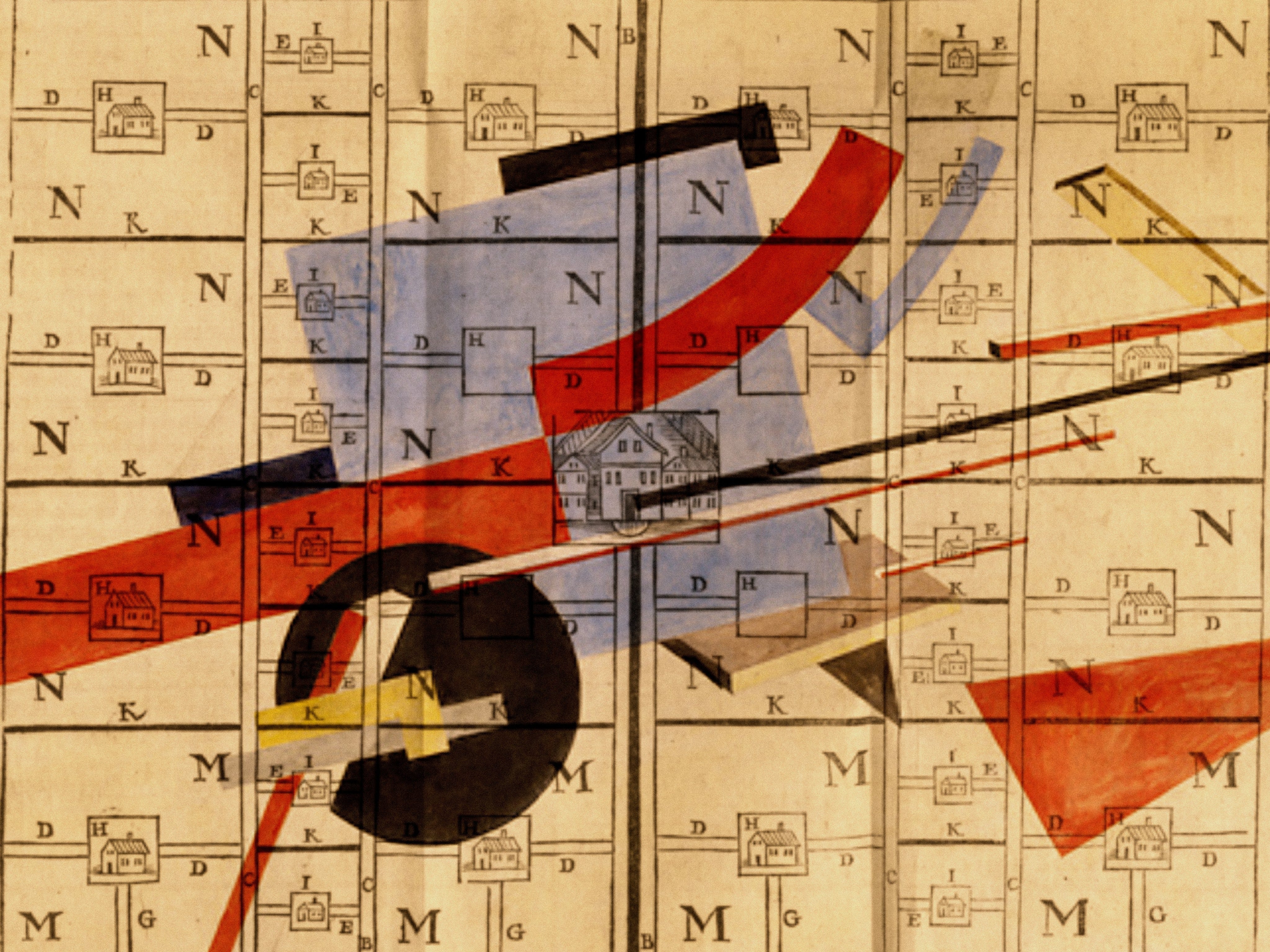
“…as the common way used is, to bow the knee of the body; so the new way should be to bow the knee of the heart: and as the common way now used is, to be every one for himselfe, so the new way should be, to be for the generall good of every one: if the last of these be not performed, the first cannot: for it is unpossible that he can honour and love God aright, which doth not love all his brethren whom God hath created upon the face of the earth; and if he love them; he will worke for the generall good of them all, which if he doe not, then his love is fained, and his Religion is vanitie.”
Gabriel Plattes, A Discovery of Infinite Treasure (1639)
In The Machiavellian Moment, J.G.A. Pocock treats political economy as a set of vocabularies, for which virtue and corruption, a conceptual antinomy central to the Machiavellist Republican tradition, constitute discursive forms rather than expressions of concrete social relations, the historical development of these tendencies playing out through the internal dialectical (discursive) maturation of their propositions. It follows then that, in Pocock’s treatment, we know Harrington as the principal standard bearer of Republicanism proper in the decade of England’s revolutionary Commonwealth. Certainly, the most direct inheritance of Machiavellist thinking is in Harrington, his conception of Republican order restrained principally to concerns of land ownership, the relationship between soldier and citizen and the rotation of offices, with notions of corruption and virtue necessarily tied to these factors. However, concurrent to Harrington, there was a tendency as distinct from his as they were from the Levellers and Diggers to whom Marxist and left-wing historians typically focus their attention. This other tendency is often understood as being broadly intellectual rather than expressly political, in some manner dislodged or aloof from the active political tumult of the period, however when seen in the light of their influence on the institutions of state and civil society after the Republic, as well as the specific points of intervention which their members made, this tendency can be revealed not as a ‘non-political’ element, but rather as constituting or expressing the forgotten (or rather, eclipsed) political ‘centre’ of England’s first Republic. The tendency under examination is that of the German-born emigre intellectual Samuel Hartlib and his Circle.
Within the papers collated from the collection of Hartlib and his correspondents one encounters a broad and sophisticated conceptual universe drawing together strands of pansophism, humanism, Platonism, reformed Christianity, husbandry, mechanisation and land improvement into an integrated system of knowledge and political-economic organisation. With regard to their discursive inheritance, the Hartlibians belong squarely in the camp of the independent Christians against both the Catholic and Presbyterian churches; for their economic position, the overall policy espoused across the Hartlibian corpus is owed to a milieu in the commercial land-improving interest of the Puritan aristocracy, in alliance with a burgeoning venture capitalist strata. Hartlib’s tendency, to which Harrington’s set paid little recorded attention – and which Pocock never mentions outright in The Machiavellian Moment – focused less on classical-Republican concerns such as the organisation of properties or civic defence and more on concepts of invention, economic organisation, improvement, and notions of development coherent to what we would today call ‘expanded reproduction’. Both this tendency and Harrington’s, as centuries pass, will iterate into the formal constituent coalition which leads the social base of America’s Revolution, yet for the time being we will treat the Hartlibian and Harringtonian elements as distinct with regards to the economic, philosophical and political arrangements of English civil society in the 1640s-50s.
Today, the figure from Hartlib’s milieu with the most enduring fame is John Milton (other figures of lasting note from the Circle include Robert Boyle and William Petty, foundational for natural philosophy and political economy respectively). We will begin by following Milton’s movement towards Samuel Hartlib and his semi-formal network of correspondents, beginning with the religious affinity which first drew the two men together. Despite the common slurs made against Independent (‘Puritan’) Christianity as simplistic or doctrinaire, Milton and his contemporaries were well versed in the conceptual dynamism of Renaissance Humanist thinking, its universalising and quasi-Paganistic retrieval of pre-Christian philosophy and so on. Educated at St Paul’s in Colet’s Erasmianism and then at Christ’s, Cambridge, Milton absorbed early the Florentine conceptual unity of Hermes Trismegistus and Plato, of Plato’s genealogical descent from Hermes through Orpheus, Aglaophamus, Pythagoras and Philolaus, cultivating the capacity to “blend unblushingly the moods of Christian piety with the beauties of pagan mythology” (Parker, 1968). Milton’s speaker in Il Penseroso (composed c. 1631, printed 1645) desires to sit with “thrice great Hermes” and “unsphere / The spirit of Plato”, and (per Sears Jayne’s scholarship) can locate Marsilio Ficino’s doctrine of love at the centre of the Ludlow Mask of 1634, betraying a depth of knowledge and cultivation in Humanism, the sister science to Classical Republicanism.
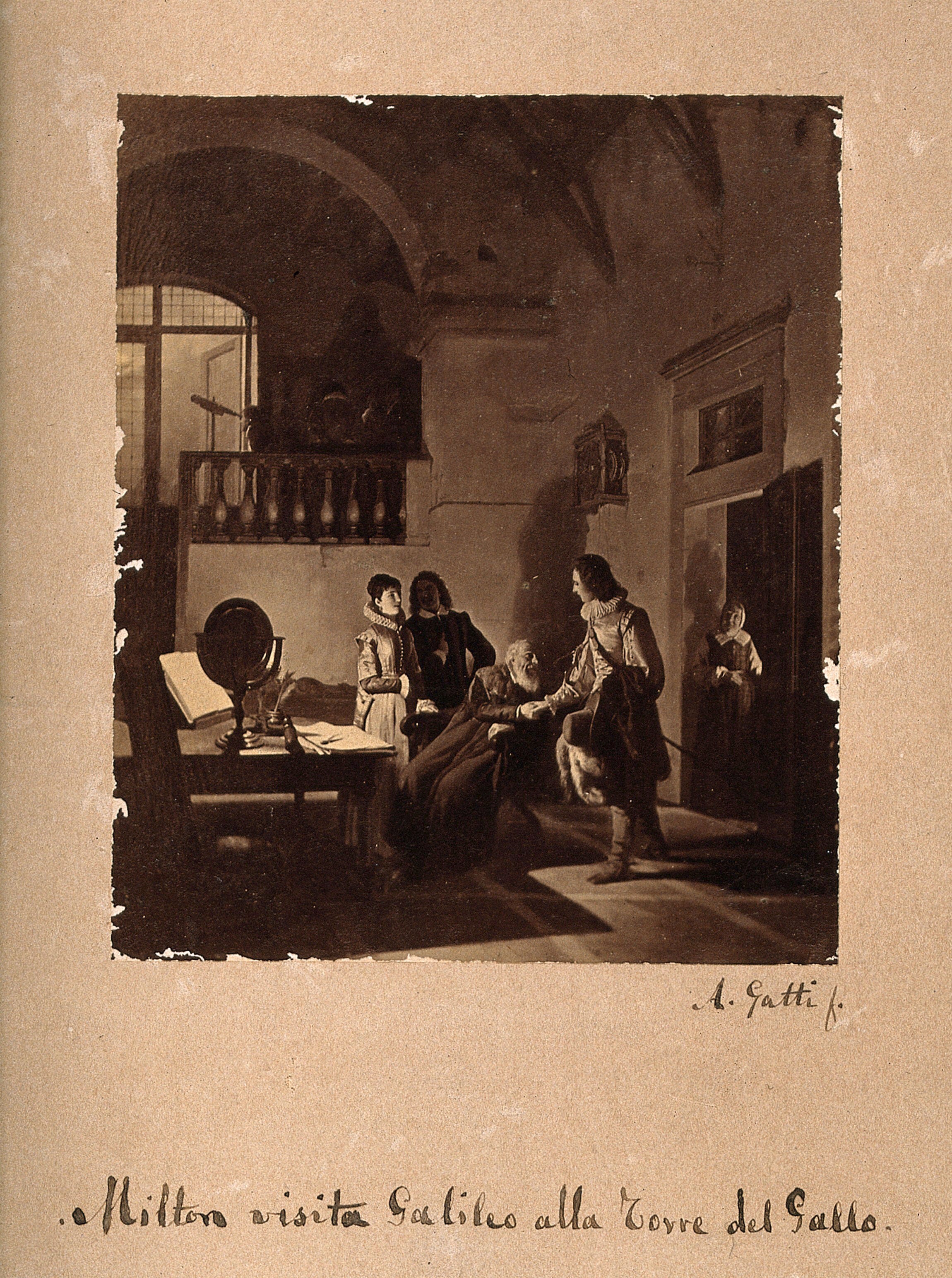
In 1638 Milton read his verses before the Florentine academies, the direct institutional heirs to Ficino; Ficino’s Academy had initially consisted of a semi-informal circle of associates and correspondents, whereas in later centuries successive Medici governments had converted the Florentine humanist inheritance from an avant-garde of intellectual dynamism into a state-directed institutional complex for the production of knowledge and consciousness through the Accademia Fiorentina and the Accademia della Crusca. Despite formalisation, certain strands of the ‘original’ Ficinian model lingered, as in the case of the private academies of the Svogliati or of the Apatisti of Agostino Coltellini and Carlo Dati respectively, to whom Milton ingratiated himself early during his stay in Florence. Milton’s account in Areopagitica (1644) records a visit to Galileo, then under house arrest, during the Italian journey of 1638-39, an encounter the tract recalls for the sake of Milton’s defence of free inquiry – a theme the author would employ during the years of the English Republic in his strident advocacy for liberty of conscience against the Commonwealth’s nascent Presbyterian elite.1
Returning to England in the summer of 1639, by 1643 Milton had become acquainted with Samuel Hartlib. Schooled initially at Brieg, Herborn, Königsberg, and then at Cambridge as a private student between about 1621 and 1626, Hartlib hailed from the utopian Protestant brotherhoods of Johann Valentin Andreae, for which the reform of Christian society was to be realised in the extension and cultivation of learning as its principle earthly objective. While at Herborn, Hartlib studied under Johann Heinrich Alsted, whose Diatribe de mille annis apocalypticis (1627), nurturing in Hartlib the apocalyptic orientation which would inform his subsequent interventions into theology, economics and politics in the future Commonwealth. Hartlib’s principle influence, the Czech pedagogue Comenius whose pansophist writings he presented and published in England, was himself profoundly influenced by the works of Nicholas of Cusa of the 15th Century among others belonging to the broader Neoplatonic milieu.2
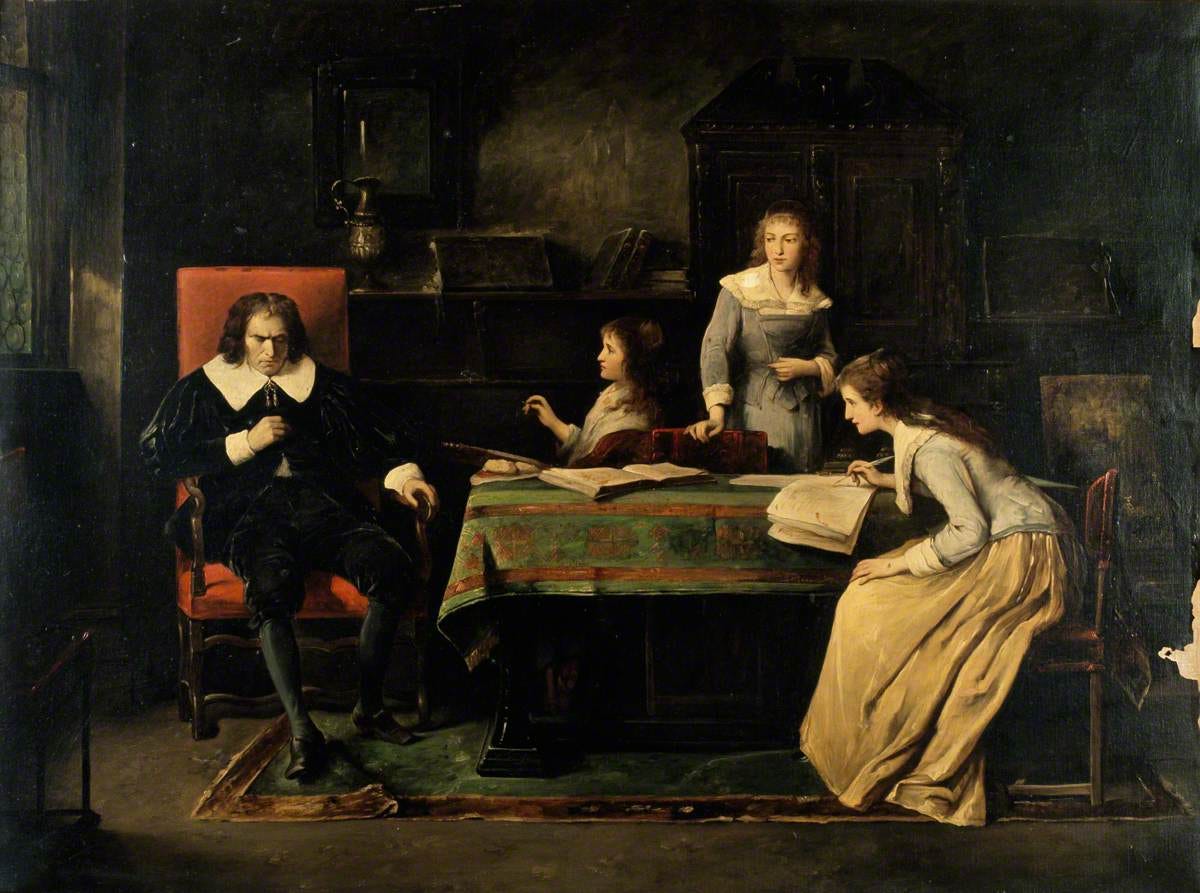
In his 1968 biography of Milton, William Riley Parker relays the relationship between Milton and Hartlib, describing the latter as “a one-man news service” with regard to his immense intelligence gathering & correspondence operation. Parker relays how Hartlib was “drawn irresistibly to new ideas and was probably one of the ‘divers learned and judicious men’ who testified their approval of [Milton’s] Doctrine and Discipline of Divorce”, an infamous tract forwarding a Christian defence of divorce.3
On settling in England in 1628, Hartlib found patrons among the members of the Providence Island Company, chartered in 1630, consisting of the Earl of Warwick, Saye & Sele, Brooke, Pym, Oliver St John and others who had endeavoured to form a Puritan colonial venture, coming to form the core of the Parliamentary opposition to the King by 1640. Pym had sent money for Hartlib’s intellectual master Comenius, glad to be “an Instrument of any incoragement to that worthy man Comenius in those workes, & designes which he hath for the publick good” (26 November 1636, HP 31/3/1A–2B4). In April 1643 Hartlib thanked the Company’s Sir Thomas Barrington for “the continuation of your liberal funds”, repaid with “Papers of my forraigne Advertisements” sent “Weekely”, and addressed Pym as “My most Honoured Patron” (HP 7/27/20A–B). In this period the East India Company raised its capital primarily through terminable joint stocks, deriving its profit by purchasing Asian goods with exported bullion to resell in Europe; concurrently, the Levant Company exchanged English cloth for silks and other Levantine goods; Both entities realised their gains principally via circulation, holding no direct command over production and avoiding long-term investment, whereas the Providence Island set allied to Warwick aimed to realise their capital in plantation production, owning outright the territory of Providence Island off the Caribbean coast of Nicaragua. Despite their attempts to engender an alternative path to profit from the East India and Levant traders, guided by Puritan ethical commitments, the Company’s poor performance and endemic disorganisation led to their relying increasingly on enslaved labour to turn profits from their plantations, then, after 1635, turning to privateering under royal letters of marque as a means to satisfy their investors.
Although Pym and Brooke died in 1643, and Saye and Sele withdrew from public life after the regicide, the economic constituency formed in the Providence Island venture was sustained into the Commonwealth period through Oliver St John, the colonial merchants around Thomson, and Benjamin Worsley, secretary to the Rump’s Council of Trade of 1650, forming a third pole in Commonwealth politics distinct from the Levellers’ small proprietors and the ‘men of big property’ from whom the Presbyterian and Moderate elements drew their support. The Providence Island experiment, with its conception of plantation development and long term fixed investment, would eventually find itself conceptually refined and rearticulated in the models of investment, improvement and credit which Hartlib and his Circle would later come to formulate in their interventions in the major political and economic debates of the English Republic.
Central to the Hartlib Circle’s economic conception was the primacy of the advancement of learning and the practical application of that knowledge to the overall economic process. In other words, we can say that the Hartlibians held knowledge to be the determinate productive force in economic and social processes. For a working definition of Hartlibian knowledge we can look to the second letter of Hartlib correspondent John Dury’s 1650 tract The Reformed Librarie-Keeper, that “there is nothing of knowledg in the minde of man, which may not bee conveniently referred to the virtues of God in Christ, whereby the humane nature is to bee exalted to that dignitie whereunto hee hath received it, that it should by him rule over the whole Creation.” In the preceding letter of the same text, Dury states that the function of the library-keeper “is to keep the publick stock of Learning, which is in Books and Manuscripts to increas it, and to propose it to others in the waie which may bee most useful unto all; his work then is to bee a Factor and Trader for helps to Learning, and a Treasurer to keep them, and a dispenser to applie them to use.” The mercantile character of the library-keeper is further evidenced in Dury’s prescription that he is to trade with scholars at home and abroad so as “to caus them to multiplie the publick stock, whereof hee is a Treasurer and Factor”, and to render a yearly account of “his Trading, and of his Profit in his Trade (as in all humane Trades Factors ought, and use to do to their principals at least once a year)”, this ideal form of learned bureaucrat being directly modelled on, and a formalisation of, the spontaneous activities of Hartlib himself.
Hartlibian knowledge has two essential features, being 1) that which extends humanity’s command over nature; and 2) that which is the active contribution to a kind of ‘public stock’ or commons, whereby each scholar adds to the general reserve of knowledge through a form of mutually beneficial exchange. Hartlib, in the preface to the above cited tract from Dury, states that these reserves are themselves “but preparatives towards that perfection which wee may exspect by the advancement of the Kingdom of Christ, wherein the Communion of Saints, by the graces of the Spirit, will swallow up all these poor Rudiments of knowledg, which wee now grope after by so manie helps.” Millennial expectation grounds their conception, yet at the same time Hartlib and his Circle consistently locate a secular realisation of knowledge in the physical, social reality of the ‘Common-wealth’ and of the ‘Commonwealths-men’ to whom agents of knowledge serve as in their mutual contribution to the nation’s (and world’s) general reserve. Knowledge is then conceived as a social fund accumulating through circulation, modelled in form on the logic of merchant capital of the period, yet specifically formulated as a commons rather than as distinctly private property. This subtle formal distinction in the use of mercantile and commercial analogy carries across other aspects of the Hartlibian programme – from here we can begin to locate, by way of a counterfactual, the outlines of a lost horizon of development, one where little or none of the later liberal conceits, owed to John Locke and his generation, can be identified.
For the active political intervention of the Hartlibians and their allies, we can look to the Republic's tithes debate. After the Tudor era’s dissolution of the Monasteries, at least a third of England’s tithe incomes came to be routed into lay hands (as Christopher Hill outlines in his 1965 Economic Problems of the Church), giving rise to the figure of the ‘lay impropriator’ in England’s economic life, the overturning of church property being a necessary factor driving the expropriation of the English peasantry, forming the social premises for primal capitalist development. Sir Henry Spelman’s 1630s investigation into the fate of former monastic property, The History and Fate of Sacrilege, was left unpublished until 1698, long after interested parties could intervene, therefore withholding its findings from civic scrutiny in the Republican period. On 19 July 1653, after the dismissal of the Rump that April, the Nominated Assembly established a Committee for Tithes. John Milton intervened directly in the tithe dispute in its final phase, with Considerations Touching the Likeliest Means to Remove Hirelings out of the Church (August 1659), addressed to the restored Rump, extending his principles regarding the liberty of conscience in religion to the political-economic organisation of the country. Milton’s central demand was that ministers be maintained voluntarily by their congregations rather than by compulsory tithe; additionally, Milton proposed that public revenues be turned towards schools and libraries for the advancement of learning.
Within the Hartlib Circle more broadly the tithe question was not conceived as merely an ecclesiastical concern, with Circle correspondent Moses Wall urging Hartlib that the Commonwealth ought to “wholly take away Tythes, which are Iewish & popish in the originall”, on the ground that their payment “doth greatly discourage the husbandman”, while the nation had spent “a million and an half of treasure” on “beyond-sea Corn” that domestic agrarians sufficiently encouraged would have made unnecessary (22 January 1659, HP 34/4/21B). The final decision was made on 10 December, when the House rejected (by 56 votes to 54) the first clause of the Committee’s report on tithes; The propertied ‘moderate’ and Presbyterian-aligned factions, seeing in the radicals’ narrow victory an attack on patronage and property altogether, would proceed to stage the early-morning session of 12 December wherein the Assembly surrendered its powers to Cromwell.5
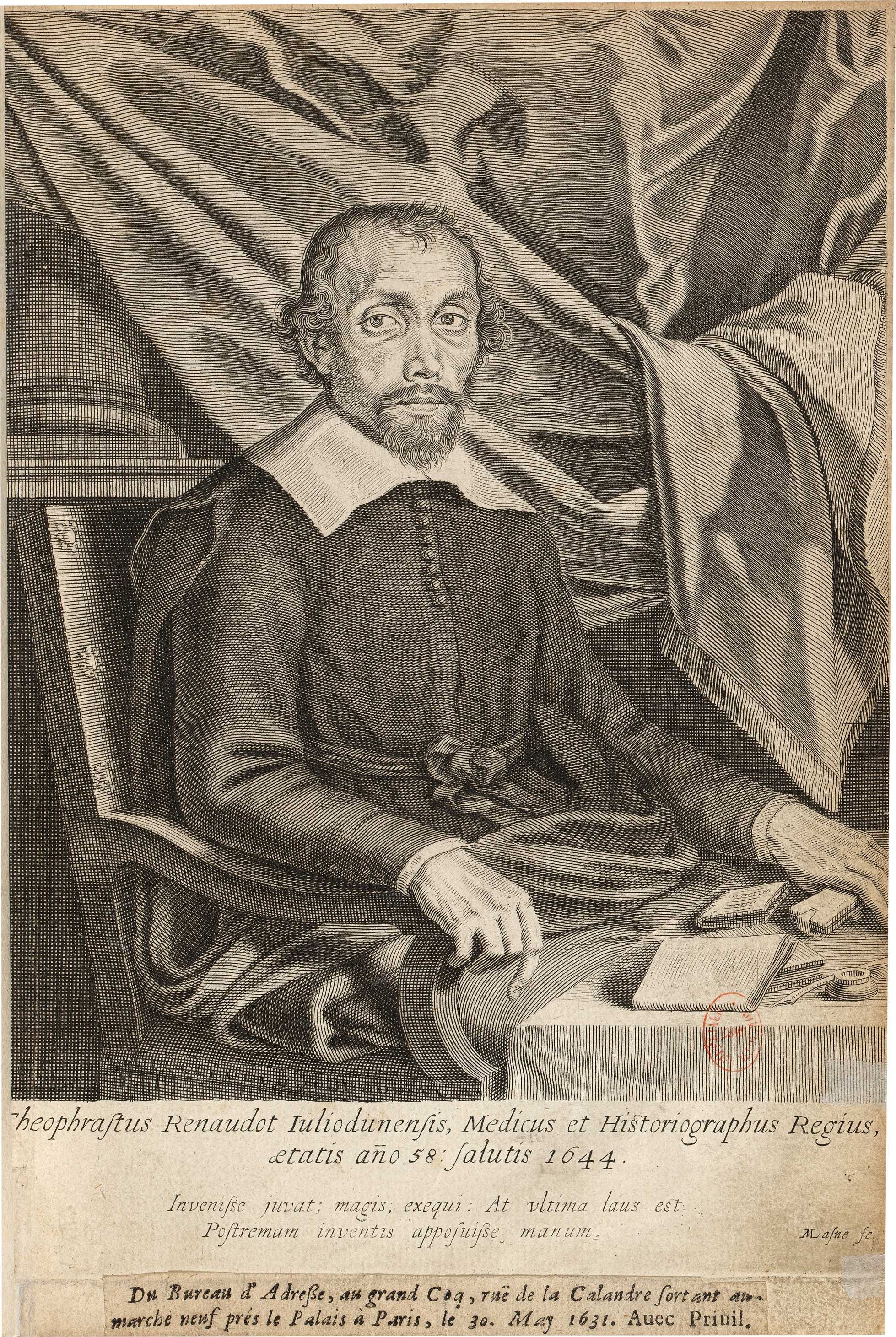
Besides the elimination of tithes, more comprehensive proposals for civic reorganisation can be found in the Considerations tending to the happy accomplishment of Englands Reformation (1647) and A Further Discoverie of the Office of Publick Addresse for Accommodations (1648), the first written by John Dury with a preface by Hartlib, the second Hartlib’s own (HP pam 21; pam 23). These pamphlets introduce a central policy of the Hartlibian programme, the Office of Address, being “a Certaine Place… designed by the Authority of the State, whereunto all Men might freely come to give Information of the Commodities which they have to be imparted unto others”. Modelled on Théophraste Renaudot’s Bureau d’Adresse in Paris, the proposal was grounded in the theory that “The chief End of Common-wealths is Society, the End of Society is Mutuall Help” (Further Discoverie, 1648): an organ of the state, centered in London, which would cultivate a network of Offices “the designe” being “to have a Commissary of Addresse placed in every great and eminent City, who shall correspond with him of London”, “so that from any place in all the Kingdom a businesse may be dispatched to any place or person”. Concurrent to the exchange of information for commercial ends, the Offices were also to keep tabs on unprovisioned people “enrolled in the List of the Poore” and to make their case known to “the Commissioners for the Poore”, with further departments overseeing proposals for the absorption of idle labour, lists of benefactors, physicians willing to treat for free, free remedies, free legal advice and advocacy, and so on.
We can see the more profound function of the proposed Office of Address in a letter sent on the 26 May 1659 by Moses Wall to Milton, wherein he relays that securing true liberty required improving fens, forests, commons and manufactures. This letter to Milton was a rearticulation of what he had written to Hartlib that January, establishing a programme for enclosure, “allotting a share to all that can iustly claime a right; and also to the Poor of every Parish that want house and land” alongside abolition of tithes and the removal of “the scars of the Norman Conquest, scilicet the base tenure of lands by Coppy-hold”, since such tenures “make people who hold, not care to improue the land throughly … because they know not how soon they or theirs may be turned out” (22 January 1659, HP 34/4/21B). Regarding the ownership of land, while rarely attacking landlords directly, the Hartlibians maintained the position that landlords ought to be compelled to undertake improvements to their land, as Gabriel Plattes lays out in his Discovery of Infinite Treasure (1639): “there be a great number of Parishes… where the Landlord by laying out of his money upon these improvements may gaine double as much, as by purchasing of new Lands… I see no reason why the Landlords should be remisse in providing the same”. Where improvements “bring not a present profit, it is fit that the Landlord should be at the charge, for that the yearely value of his land is advanced”. Ralph Austen went further, proposing to Hartlib a law under which tenants who planted fruit trees “on their Landlords grounds” should “hould the same after the expiration of their Tearmes” until, in the judgement of two honest men, they had received “a convenient, & encourageing recompence” (26 September 1653, HP 41/1/52B).
With regard to labour, the agriculturalist Cressy Dymock conceives of a fundamental unity in the notions of improvement, growth and productive capacity through machinery. Amongst Dymock’s schemes included projects for enclosing and dividing farmland, breeding rabbits and planting fruit trees, a seed drill, and “a perpetuall motion” device, announced to Hartlib on 25 December 1648, which would be fit for small tasks such as “turning of grind stones[,] winnowing of Corne, churning of butter”, for the “drayning of waters” as well as for use in “Iron mills, Corne mils, sugar mils, oyle mils” and the moving of “carriages of all sorts” (HP 62/50/2A). By the printing of the Invention of Engines of Motion lately Brought to Perfection (1651) this general-purpose labour-saving machine was said to be applicable to nearly any task at any scale, whose “Marriage of Strength and tyme” (HP 62/50/9A) Dymock set against the drudgery of peasant toil. In an undated memorandum Dymock set out the ambitions he held for the invention: existing practice required teams of “4 -5- or -6 horses & 6 or 8 oxen”, guided by “two men or a man & a boy att least”, to plough “about one acre a day”, whereas he hoped “without any horse with 6 men onely or lesse to plough with two ploughs att once” and “to plough two acres a day” (HP 67/13/1A).6 Dymock’s conception of growth, determined according to a basic ratio of output to labour per acre per day, would on these projections be calculated from the quantity of land turned over from fodder to wheat, as well as to the absorption rate of labour who would otherwise have been displaced by the use of labour saving technology. Dymock appealed to what he was “assured both by reason and experience” against farmers’ attachment to “old customes” or “negligence”, and in A Discoverie for Division or Setting Out of Land (1653) claimed that rational layout alone would “improve the value of [an] Estate one half part”, so that land “really worth 100li. per annum” would become “as really worth 150li. per annum” (HP pam 46).
Dymock’s Discoverie of 1653 was printed with “An Essay to shew How all Lands may be improved in a New Way to become the ground of the increase of Trading and Revenue to this Common-wealth”, attributed to Sir Cheney Culpeper and written upon “Master W. Potters Designe” (HP pam 46). The ‘design’ in question is that of William Potter, whose theories of credit and economy more broadly afford us an insight into the Circle’s most radical break with prior thinking with regard to economics. Potter’s Key of Wealth (1650) holds that money is worth nothing in itself besides as “an Evidence or Testimony” of the extent to which persons, “by their joynt Agreement to take it, being otherwise of no worth”, are “Indebted” to one another in a “publique Obligation”. From this Potter establishes how the more money or credit circulates, the more wealth may be generated, that ten times the money, turning over ten times as fast, would make trade “neer 100 times more” without raising prices, provided land can be made “to yield much more Commodity out of its own Bowels”. Trade so set in motion, like “fire that wants no fewel”, multiplies itself “ad infinitum”, constituting a notion of growth tied directly to systems of improvement and expanded (agrarian) reproduction.
Potter’s views on circulation and economy, while novel for their period, can be understood within the broader conceptual framework of the Circle, grounded in a conception of wealth and resources which denied the plausibility of limits to growth. The established view amongst scholars of the period was that the world’s goods were a fixed and depletable stock. Florio’s translation of Montaigne decrees that “The profit of one man is the damage of another”, insisting that “no man profiteth but by the losse of others” and that, even in nature, “The birth, increase, and augmentation of every thing, is the alteration and corruption of another” (Essays, 1613). This was extended by Bacon to explicitly pertain to the geopolitical, that “the increase of any Estate, must be vpon the Forrainer, (for whatsoeuer is some where gotten, is some where lost)” (Essayes, 1625). The East India Company’s Thomas Mun would later render this formula even more explicit, reducing national enrichment to a single maxim: “to sell more to strangers yearly than wee consume of theirs in value” (England’s Treasure by Forraign Trade, written ~1630 & published 1664). Against this inherited conception of wealth and its proportionality, Gabriel Plattes follows from the Book of Proverbs that “he that gathereth by labour shall prosper”, that there exists in the bowels of the Earth an “infinite and inexhaustible treasure which it produceth continually”. Improvement was then realised as a policy to render England “the Paradise of the World”, that by dirigistic interventions into agriculture the state could achieve a “better cure for an over-peopled Common-wealth, then to make violent incursions upon others territories”, extending this principle further still that the whole world “is or should be one body Politique”. This conception is then reiterated in 1651, in the Essay for Advancement of Husbandry-Learning which Hartlib published with Dymock’s proposals for a college of husbandry, stating that England “hath in its bowels an (even almost) infinite, and inexhaustible treasure”, of which “we enjoy not, know not, use not, the one tenth part”. A Philosophical Quere concerning the Cause of Fruitfulness, appended to Dymock’s Discoverie, asked “whether the Earth, by reason of the Divine Benediction hath an Infinite, multiplicative Vertue, as Fire” (1653, p. 16). To these 17th Century conceptions of infinite treasure we can find more recent interventions on similar lines in theories of the deep abiotic origin of petroleum, advanced by Soviet geologists starting in 1951 with the work of N. A. Kudryavtsev and his colleagues, as well as Thomas Gold’s ‘deep-hot biosphere’ hypothesis.

Further to his theories of circulation, analysed in relation to Dymock’s ‘infinite treasure’, Potter’s economic thinking reaches its most mature form in the “Bank of Lands” concept laid forth in his 1653 work. Hartlib maintained Pico della Mirandola’s claim that gold had not always served, “consensu Nationum”, as the measure of other things so as to “illustrate Potter’s designe for Bank of Lands” (HP 29/4/3A): the mechanism would function according to credit secured on registered land at double its value, with all payments above ten or twenty pounds made in Bank-Credit (HP 27/14/1A–2A). The essay on Potter’s design attributed to Culpeper demonstrates “How all Lands may be improved in a New Way to become the ground of the increase of Trading and Revenue to this Common-wealth”, bound into the same 1653 volume as the Quere quoted above. Here the infinite treasure attains its highest economic realisation, with land, being endlessly improvable, assuming the function of an endlessly expandable collateral. The Bank of Lands would function so as to monetise the owner’s title to a share of future surplus, therefore constituting a kind of fictitious capital oriented towards the realisation of claims on future surplus value for the ends of greater and greater levels of overall output and productivity. Further to Potter’s theories, an anonymous memorandum amongst Hartlib’s papers observes that credit, where it “gives content”, will “fully (& in all kinds whatsoever) supply the office & place of money”. The memorandum proposes credit secured on registered land, and on staple commodities (“Iron, Tinne, Lead, Woole, Cloath, Leather &c”) pawned in the bank at double their value, with all payments above ten or twenty pounds to be made in Bank-Credit (HP 27/14/1A–2A).
While not subjected to the persecution as suffered by the Levellers or the Diggers, the Commonwealth’s leadership declined to adopt in full the policies laid forth by Wall, Potter, Dymock, Hartlib, Milton, and the other Circle associates. On the economic side, the Presbyterian-dominated Parliament opted to finance state activities principally by way of borrowing at short term from Amsterdam banks, goldsmiths and City lenders, or from the rents and collateralisation of confiscated land. This transfer of property to syndicates of Dutch and City merchants, army officers and Members of Parliament spread landlord interests through new social layers and, in the longue durée, served to undermine the capacity for the Republic’s economic foundation to prosper. Potter’s proposed system whereby credit would be issued against the future product of improved land would have instead served to tie public finance to the development of agriculture and to the productive forces as a whole, rather than to the redistribution of existing property; Set against Marx’s account of the formation of the English banking system in Capital, Vol. I, ch. 31, Potter’s banking theories grounded in the concepts of resource extraction and labour absorption from Dymock, represent a lost path of development whereby public credit is tied to the improvement of production rather than to war finance and rentierism.
At the Restoration of Monarchy in 1660, Hartlib had found himself stripped of his Parliamentary pension, his health declining, with his network re-establishing itself in other quarters. John Milton was by that time fully blind and, with his spirit already broken by the Republic’s collapse, had been turned fugitive by decree of the fledgling Royalist state of Charles II. The depth of despair to which these Republican intellectuals must have succumbed can be compared to the circumstances of the late Soviets. In place of Hartlib’s original Circle of correspondents and collaborators, the new regime chartered the Royal Society in 1662, to which a significant part of the original Circle were founding members. A letter dated December 1661 by Hartlib’s associate John Beale to Henry Oldenburg encloses a letter to Hartlib wherein Beale announced that he had found it necessary to leave the curiosities of theology, before moving on to discuss how cider-making in Somerset could be improved. At the fall of Cromwell, the philosophical ground of the Hartlibian program is cast aside while its practical concerns persist, developing autonomously from their prior millenarian grounding. This transformation amongst the post-Hartlibian milieu is further evidenced by John Evelyn, a founding member of the Royal Society and Hartlib correspondent, who increasingly withdrew from the organisation as it began to leave behind its original humanist function as an instrument for the overcoming of social, economic, and spiritual problems.
Before the Restoration, Benjamin Worsley, central both to Hartlib’s network and Puritan venture capital after Providence Island, was made a secretary to the Council of Trade in August 1650. After the Restoration, Worsley rose to become Secretary and Treasurer to the Council for Trade and Foreign Plantations in 1672, but as a consistent Independent and Nonconformist in faith he resigned the following year. John Locke, who had acted as his secretary for a year, replaced him in post, thus instantiating the transition from the old order to the new. Locke’s relationship to Hartlib and the Circle more broadly isn’t straightforwardly antagonistic, yet his tenure demonstrates the process whereby the various Hartlibian threads were disentangled in the immediate period of Restoration leading up to the Glorious Revolution. Whereas Locke inherited much of the Hartlibian vocabulary – improvement, labour, the “common stock,” the productive poor, etc. – the metaphysical foundations on which these categories rested were upturned. Under Locke, the concept of property transferred from a conditional trust held for the Commonwealth as a whole to that of a natural right existing a priori to political forms. Likewise, knowledge was unrooted from its grounding in the collective, cumulative public stock transmitted through state institutions into the category of an individual achievement of the mind (whose printed representation could then be held as the limited private property of its originator).
Returning to the Circle proper, William Potter’s design assumes that credit secured on land and goods could be insulated from the reversion Marx would later take account of in Capital regarding modern economic development from its nascence in primitive accumulation. Questions arise, then, as to the extent to which the path of development which took place in actuality, the real process of primitive accumulation and early capitalism, must have necessarily occurred as it did. Of course, materialism forces us to concede and affirm; whether a bank tied to improvement rather than to war and expansion would have perhaps achieved alternate ends, while being an interesting counterfactual, can only remain so by the fact that the Hartlibian system was crushed before it had an opportunity to take root.
The system forged in the centuries succeeding our first Republic, what would go on to become the British Empire, is something radically distinct, yet paradoxically born in large part by the work undertaken by Hartlib and his correspondents. What the Circle demonstrates, specifically in light of the traumatised cynicism which defined the intellectual culture of Restoration England through the Royal Society, draws into view questions concerning the role of theory and conceptualisation with regard to liberty of thought and hopeful expectation within the overall process of material, historical, economic development. For the reconstruction of a Republican form of Government in this country it serves us well to note the Restoration in the fullness of its historical consequences, then chart from there (if only for the sake of argument) a different trajectory.
By a later account of his European journey (Defensio Secunda, 1654) it was while in Naples that Milton caught word of the looming civil war in England, forcing him to abandon his grand tour and return home, though not before stopping back in Rome, Florence, and then Geneva, home to Giovanni Diodati whose translation of the Bible served as a crucial device for the reforming movement across Europe. By the same account, English merchants came to warn him that the English Jesuits in Rome had laid plots against him should he return there, on account of his frank speech about religion; he returned regardless.
Hartlib and Milton shared a deep conceptual affinity with Cusa, seen on Milton's side through resonance between Cusa’s Coincidentia Oppositorum (unity of opposites) and the complex articulation of dialectical antagonisms in Paradise Lost.
Parker continues: “If, as seems likely, he made Milton’s acquaintance after the publication of this pamphlet, he was subsequently delighted to learn that Milton also had notions about the reform of education. In his notebook for 1643 he made this memorandum: ‘Mr. Milton in Aldersgate Street has written many good books – a great traveller and full of projects and inventions.’” In November 1643 Hartlib collected subscriptions for the inventor Edmond Felton, of which the list records “Mr Milton three shillings” (HP 8/40/8A). If this is the poet rather than his father, who was by then living in his household, it places Milton among the paying supporters of a weapon devised by a Hartlibian inventor, “of 3 tire of ten Musquets in a tire to shoot Arrows withall” advertised as being “For good of a State, In tyme of Warre” (HP 8/40/11A).
This, along with other sources listed as ‘HP’, refers to a reference code in the Hartlib Papers. The source material can be found by searching the reference after the letters ‘HP’ here.
The above draws into view that the survival of the Republic foundered not on questions of constitutional or religious legitimacy, but more decisively on the question of tithe, of which the Hartlibians found themselves united with the more ‘radical’ Leveller and Digger factions in their critique.
Not attaining the maximal results he had hoped for, his trials of improved ploughs in March 1653 were more modest and concrete in their results: two ploughs “dispatched about three Acres” in a day, which he expected that eight working together would “dispatch at least 12 acres a day”, or “at least 20 if not 24” at unequal distances (HP 64/17).
The writing in this essay is once again excellent, and I am glad this publication is back to posting. Yet for the unintroduced reader there is quite little context to make sense of the story at hand.
I can see there are some excellent thoughts here but I’d suggest some further introduction to the theories discussed.