


It’s become something of a tired point, but it’s undeniable that British heatwaves are relentless. Something clawing about them that just won’t leave you alone, especially here in London where we’re all packed together like a tin of sardines. Or a pack of jackals, perhaps, which have taken to huddling up in European cities in recent years, spikes in population chalked up to climate change. The jackal is the face of Anubis, god of the dead, now stalking westward to unusual climes in Germany, Poland, and Brussels. Anubis was famously the patron of mummification, wrapping corpses in thick bandages for their journey to the afterlife – an unthinkable torture in this heat. So I stand with the Pope this week who called for an end to the ‘idolatry of profit’ in his first encyclical, Magnifica Humanitas; smash the icons and be rid of this intolerable state of affairs. Take off these criss-cross choke-bands of irrational supply chain management, discard the liturgy of bureaucrats, stop tithing us for our time, and give the houses of the gods back to the people. I’ll pray on it. Or maybe I’ll talk to Claude about it. Feels like I’ve got a lot to relate to a San Francisco data centre right now.
— S.E.P.
(Note: the Other Editor wishes to state publicly and for the record that he’s very much enjoying the heat, even if it has meant delays in at least two articles he wanted to put out last week. It is a weak excuse, of course, but it is what it is. If the Aten permits it, regular one-to-two articles per-week shall return in due course.)
Cybernetic Planning Is Here

A new paper published by the npj Science of Food journal has demonstrated new levels of AI end-to-end algorithmic matching. The researchers used AI tools to develop a complex food distribution system which can seamlessly match predicted nutritional requirements, from datasets as small as individual glucose levels, to localised supply chain distribution and management. The outcome is a theoretical equilibrium between supply and demand which, when scaled alongside advanced quantum computing models, has the potential to reshape the entire food distribution system worldwide.
The research points to the very real present capabilities of AI supply chain management to orchestrate automated planning. The model’s sensitivity to biological minutiae is so extreme as to largely discount the application of these complex systems to any but a small upper-middle class Western consumer base, at least with immediately attainable tech solutions. But the idea that such minute datasets are required to appease the nutritional preferences of a small elite suggests that larger datasets focused on broader social demand are now feasible for global planning.
The research effectively points to the capacity for AI to replace price signals for both supply and demand, were the political direction asserted for its application. The political restrictions of the present moment are also made ludicrously evident.
In a recent article economist Branko Milanovic discussed the long-term potential outcomes for automation on this scale in both Marxian and Neoclassical frames, with both models pointing to the same outcome: capital becomes entirely unsustainable without an active labour force, either due to the declining rate of profit or the destruction of a productive consumer base, respectively. The outcome is not necessarily the socialisation of wealth, however. With remnant political institutions and practically unshakeable monopolisation by capital investors, a perhaps more likely outcome following the status quo is the collapse into a total rentier society and UBI guarantee for the sake of minimal consumption, with a small service workforce maintained as a new middle class. What potentially emerges is a new class struggle between a remnant, union-protected proletariat in the middle, a small elite of techno-bureaucrats and financiers (read planners, i.e. bureaucrats), and a large bottom layer post-proletariat kept sufficiently docile by social media and UBI - nutrition-based supply chain planning serving only the interests of a small elite, ‘socialism for the rich.’
If unemployment trends persist, Big Tech maintains its stranglehold over the means of organisation, and the working class remains divided and subdued by limited trade union consciousness, it does appear the more likely scenario than perhaps Aaron Bastani & co’s optimistic Fully Automated Luxury Communism.
Regardless, the technology for dynamic socialist planning is no longer a theoretical concept demanding research at scale. The research stage is reaching completion, the question remains as to who will develop it, and who will own it.
EU Tries to Break Free

Hyperscaler bond issuance has now reached record-breaking levels, with 15% of global bonds issued by the Big Five tech firms in 2026 (Amazon, Alphabet, Meta, Oracle, and Microsoft). In effect, Big Tech is now not only in control of the infrastructure of the emerging market, but the policy decisions of the state.
In an attempt to curb overall Big Tech dominance in domestic markets, the European Commission is set to introduce its Tech Sovereignty Package on 3 June. The package will follow the UK’s own SovereignAI programme to inject large amounts of state capital into the tech market in an effort to attract local startups and prevent talent from being rerouted to the US. It also seeks to encourage a shift in state buying patterns, with 70% of current tech expenditure by the public sector going straight to the Big Five.
Serious doubts about the viability of these sovereignty schemes persist, however. Although the public sector does possess a significant amount of purchasing power, it also lacks meaningful cloud infrastructure. It is all well and good for software to be ‘Made in Europe’, but it is still entirely dependent on US data centres owned by Oracle for them to be run. Ease of integration is also a major problem of onboarding, as tech systems designed for in-house integration pose major logistical hurdles for introducing third-party, ‘sovereign’ programmes. Indeed, EU bodies which are beginning to implement new tech solutions have opted consistently for single developer systems where possible.
The pace of governance is also of concern. Task fulfilment is at machine pace when it comes to AI engineering, far exceeding what is possible for human programmers - but compliance, governance, and policy regulations reduce actual throughput back to human pace, as AI systems cannot fulfil these outcomes autonomously. European tech firms like Mistral have openly protested the EU’s tight market regulations as disincentivising both supply and demand for home-grown AI.
There are potential solutions to these problems. One of the major issues with sovereign AI scaling schemes is that whilst they promote financial investment in domestic AI companies, they stop short of actually attempting to break infrastructural dependencies which keep the Big Five dominant in the domestic market. Were governments to demand their purchases be open-source, local firms would be able to continue development in cloud infrastructure and software modelling without having to resort to private scale systems from Big Tech. Peer-Production Licenses for platform co-operative developers and improved financial incentives for these types of firms to scale would also help to not only keep software free-flowing within the public sector, but also purposefully exclude Big Tech from being able to poach and redevelop novel sovereign software.
With regard to governance issues, proposals have been made about ‘Policy as Code’, essentially coding governance into AI systems autonomously so as to eliminate the need for a human bureaucracy. This would undoubtedly ramp up the pace of production without requiring reckless deregulation, but would also upset a large body of techno-bureaucrats who hold significant influence over the European Commission. And here lies the core issue. Even with these solutions available, the political influence of policy bureaucrats and Big Tech bondholders actively disincentivises and in some cases paralyses state actors from genuine ‘sovereign’ development, forever entrapping state spending power in Silicon Valley monopoly giants. One of the EU’s first major ‘sovereign’ partners, considered a model for the upcoming package, was in fact a joint venture with Alphabet, and with 70% of all EU-wide tech already owned and operated by the Big Five, the logistics of overhaul, let alone cost or political will, may very well render these sovereignty packages nothing more than further fuel to foreign monopolies.
Real Wages In Meltdown
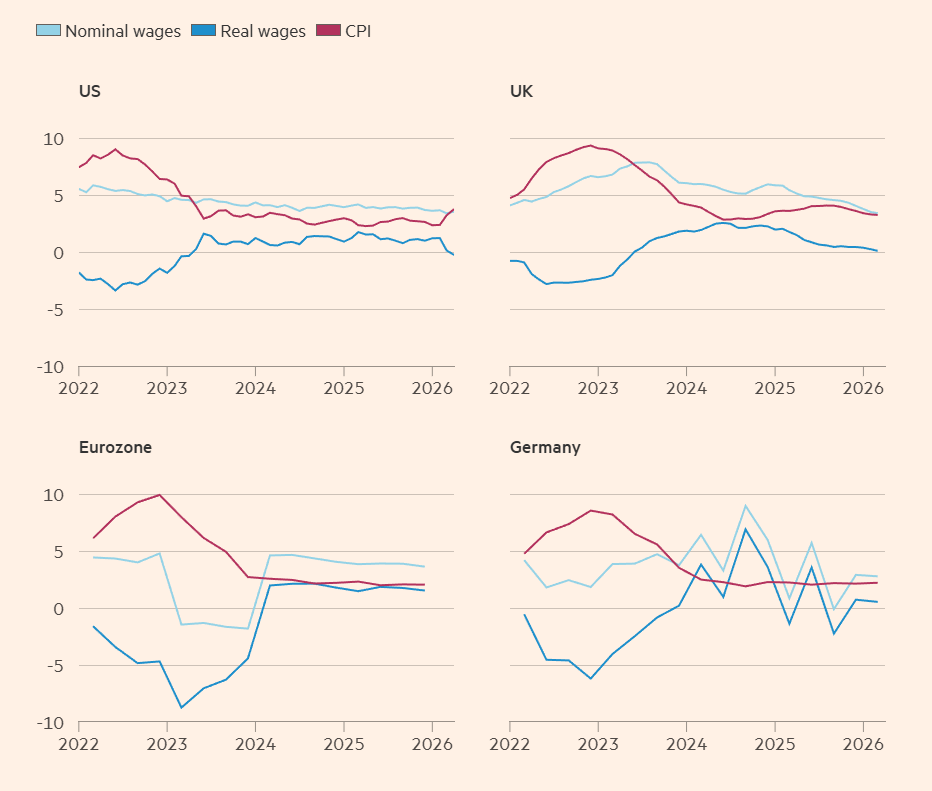
Real wages are in freefall in developed countries as supply chain disruptions caused by the war in Iran continue on into their fourth month. We have covered several of the key materials shortages being caused by the war in prior INDEXES, including plastics and aluminiums, however the sizeable impact on wages is exacerbating an impending price storm expected to hit towards the end of this summer.
Average earnings in the UK grew by a measly 0.1% over the last three months, and are expected to shrink outright in the face of the price spike. This trend is also being observed in the US and EU, with Spain the only nominal outlier of the year so far. This of course will tighten consumer spending habits, especially in the run-up to Christmas (with last year proving disastrous for high streets already), and incentivise union agitation for higher wages, likely leading to greater instances of strike action and putting further pressure on the labour market.
This comes as the UK government recently produced the diagnostic element of its report on youth unemployment, which has risen to 16% of all young people in 2026 (see INDEX 6). The second part of the report is expected for Autumn this year, when plans to overcome the socio-cultural issues associated with long-term youth unemployment may be rudely interrupted by a price-spiral market unwilling to take on new employees.
Wages are declining, prices are rising, jobs are growing scarce, and the next generation have no workplace experience. The UK labour market is in a terribly poor situation, an economy shrinking on the back of a post-proletariat whose primary economic function has shrunk to servicing public debt through consumptive taxes.
Manchesterism in Action?

The first official consultation for the planned Mayoral Development Corporation (MDC) in Middleton was opened to Middletonians this week as the corporation looks to get its feet off the ground in what may be a pathfinding experiment in civil infrastructure. MDCs typically consist of public-private partnerships, with the occasional resident representative, aimed toward developing local areas through land acquisition, development subsidies, and streamlined planning processes.
Middleton MDC represents a significant change, however, with the direct involvement of local and national co-operative bodies, Middleton Co-operating and Co-operatives UK, respectively. For the first time, community worker-owned partners hold a stake in the corporation, experimenting with grafting the horizontal, resource-pooling logic of the Italian contratto di rete discussed in INDEX 5 onto a statutory, top-down British administrative vehicle (though the state still fundamentally controls the MDC - still a while to go yet).
The MDC promises to deliver social housing and local trade facilitation in an exercise of devolved economic development. It turns the head on what has been a series of drawn out experiments in top-down local initiatives with mixed results, from David Cameron’s Big Society to Boris Johnson’s Levelling Up and now Keir Starmer’s Pride in Place. MDC Middleton has instead generated much of its initial momentum from the community-organised Middleton Co-operating, an organisation which aims to support credit union and mutualist facilitation within the Middleton area. Alongside Rose Marley, the chief executive of Co-operatives UK, the national coordinating body for British co-operatives, local stakeholders will co-chair the MDC. The measure of the corporation’s success will be the measure for future localist development in the country, as well as co-operative leadership in such plans, for national policy - especially with keen supporter Andy Burnham hoping to make his way into No 10 if he wins the Makerfield by-election coming up next month.
Co-operation offers attractive solutions to many social policy concerns and local development issues, even at scale, as has recently been shown in Africa. The African Co-operative Housing Conference, held this year, pointed to the immense success the growth of co-operative housing developments have had for the African housing crisis, with key examples in Kenya, Uganda, and the conference host Nigeria showing rapid development and affordability not pegged to corrupt and sluggish government bureaucracies and uninterested and non-compliant private developers. Success has been so far-reaching as to initiate discussions to implement a continent-wide Blockchain network for land registries in order to massively streamline future co-operative land acquisition and development.
Such technology may in fact offer a potential solution to long-standing concerns around land value capture. The policy idea has recently returned to discourse on the back of Andy Burnham’s preference for the idea as a solution to housing issues in the UK, but has often been shut down due to the large bureaucratic requirements to calculate land values. A decentralised blockchain registry may ease this process, making implementation faster and less controversial. This would also help to ease the process of co-operative land acquisition in the UK, making projects like MDC Middleton more capable to scale.
INDEX Verdict
The technological leaps and bounds being made by AI are real, but they may prove fruitless in our present economic situation, regardless of their performance. Techno-bureaucratic monopolies can do little to slow the decline in profits resulting from their own innovations, and state actors are powerless to shift their debt dependencies alone. But alternative solutions are emergent, from blockchain-backed housing in Abuja to credit unions in Middleton. When the question is no longer if we can rationalise the economy, but who will draw up the plan, we should look encouragingly towards models which give labour a seat at the table, to make its reasonable demand for leisure, and an end to the idolatry of profit.