


Monday 20 – Friday 24 April, 2026
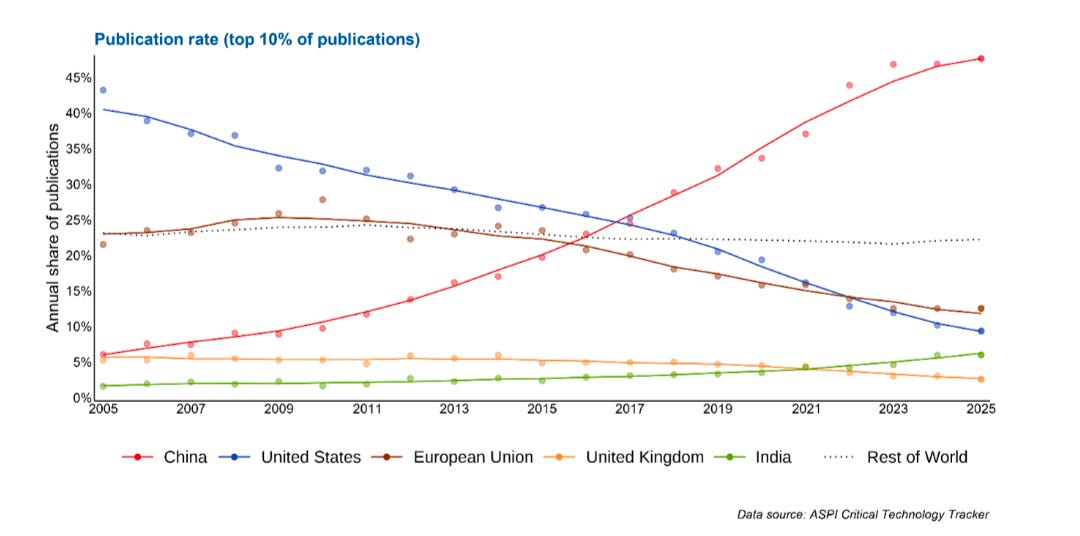
Honor’s ‘Lightning’ humanoid robot wins the Beijing E-Town half-marathon, clocking 50 minutes and 26 seconds. This shatters the human world record of 57:20 by 6 minutes and 54 seconds. ASPI confirms China now leads the US in high-impact research for 66 out of 74 strategic technologies. The US retains a narrowing lead in only 8 fields, primarily foundational LLMs and biotechnology.
Helion Energy maintains its 2028 deadline for Microsoft’s first commercial fusion plant. However, observers cite a ‘Supply Chain Paradox’: Helion’s aneutronic reactor requires Helium-3, yet NASA’s VIPER rover (the primary vehicle for lunar ice and mineral prospecting, vital for acquiring the rare element at scale) is cancelled due to federal budget caps, forcing reliance on speculative gambles with Musk’s SpaceX and Bezos’ Blue Origin spacecraft designs.
RMT drivers execute two 24-hour tranches of strike action (April 21–24), shutting down the Piccadilly, Circle, and Waterloo & City lines. The union rejects the ‘voluntary’ 4-day week, citing a refusal to accept 36-hour shift compression without a real reduction in the working week.
Palantir releases a 22-point summary of The Technological Republic, a programme for a ‘radically technocratic’ state. It marks the first time a major defence contractor has openly proposed replacing traditional democratic oversight with algorithmic targeting and data-fusion governance.
Chinese Lightning

Chinese smartphone producer Honor won first prize in the half marathon in Beijing on Sunday, with their record-beating athlete, Lightning. In a demonstration of Chinese technological capacity, several tech firms contributed to the second human-humanoid half marathon in Beijing to showcase and compete in robotics advancement. Last year’s race did not yield a single robot that could cross the finish line. This year, few didn’t, with Lightning, Honor’s winning machine, beating the human world record set this March by almost 7 minutes. Further to Honor’s win, humanoid robots have for the first time outperformed quadrupeds (robot dogs) at Unitree Robotics, one of China’s largest robotics firms.
The defeat of man by machine on level footing serves as an ideal symbolic representation of the leaps made in the last few years from robotics to AI to quantum computing, and in particular another leap for China, already outpacing the United States by a significant margin. Humanoid robotic output is completely dominated by China, responsible for 94% of production and 80% of global shipments.
China’s renewable energy output more than triples that of the US, with 3,399 TWh of production yoy, dominating in domestic output on top of a well-established saturation in the global renewables supply chain. According to the ASPI Critical Technology Tracker, an index covering national leadership in a range of technologies, China now leads in 66/74 of all total technologies in development, including quantum computing, defence, space, and energy, with the US retaining only a marginal lead in fields like biotech and LLMs.
Chinese technological advancement is not restricted to commercial and developmental output, also having a seismic and planned effect on the domestic labour market. While many in the West anxiously await the seemingly inevitable AI-induced unemployment shock, the CCP’s AI+ initiative, a vital component of the 14th and 15th Five-Year Plans, has seen nationwide efforts to encourage universal competency with New Quality Productive Forces (the economic planners’ category for a wide range of developments across AI, Quantum Computing, robotics, and renewables). Collaborative robotics (or, ‘Cobotics’) and other features of Chinese technological rollout in industries ranging from manufacturing to pharmaceuticals demonstrates a keen social awareness and active effort to see these technologies successfully integrated into the existing labour market, rather than the unregulated tendency of major Western firms to find ways for these technologies to simply replace human labour and shore up ‘profit’. The state and party’s overall leadership and guidance in the pace of technological output is leading to a model for labour automation that will soon be formidable.
It should be said that technological prowess has not entirely evaporated in the West, and indeed as discussed in last week’s INDEX, Europe and North America continue to lead in overall investment, speculation, and hope for the productivity to be unleashed by the full deployment of AI and AGI. Although China does possess, unbeknownst to many, a thriving space programme with its own space station (soon to be the only inhabited station in orbit after the ISS de-orbits in 2030), NASA’s recent trip around the Moon advises against being unappreciative of the continued dominance, at least in terms of capacity, of Western technology. But there is a decidedly different tone between the isolated men and women drifting in space as part of a programme looking to take bids for lunar commercial opportunities with the likes of SpaceX and Blue Origin, and the eager and amused faces of Chinese worker-athletes watching on as their robots race past to exceed their capacity to run, and overcome their need to toil.
Fusion by 2028?
If Silicon Valley is to be believed, the AI furor engulfing American debt markets may be providing larger dividends faster than we expected. OpenAI, a company described as the largest loss-maker in history – set to lose $14bn this year alone and expecting $115bn in losses before they ever turn a profit – have sought to cover losses (and in part help independently power their data centres) by setting up nuclear energy R&D firm Helion, who made the claim this Sunday to be able to provide fusion power to Microsoft by 2028. This would be the world’s first direct energy transfer from fusion production for commercial use – however, as reported in the Financial Times, observers are highly sceptical of the likelihood of this timeline.
Helion specialises in a specific type of heat-induction generation rather than typical water-boiling generation that most nuclear power facilities use. It also uses Helium-3 rather than Tritium to achieve fusion. Helium-3 is aneutronic, which makes heat-induction far more efficient than steam power – up to 95 per cent efficiency – and means the level of damage caused by charged neutrons to the reactor itself is minimised, allowing it to run for longer with fewer repairs. The downside to Helium-3 is that it is incredibly rare, with most known quantities existing exclusively on the Moon, making the prospect of Helion generating at scale highly unlikely in the near-term. Helion has never demonstrated its capacity to generate efficient fusion energy. One of the main obstacles to fusion generation is efficiency, as typical fusion requires far greater energy to achieve than it releases. Whilst it has been proven possible by the US National Ignition Facility, Helion have yet to prove their own capability, let alone with the novel heat-induction method they propose. Helion has claimed that their lack of demonstrations is due to patent protection concerns, but observers in the Financial Times on Monday noted that the benefits of a successful demonstration would far outweigh the potential copycat risk.
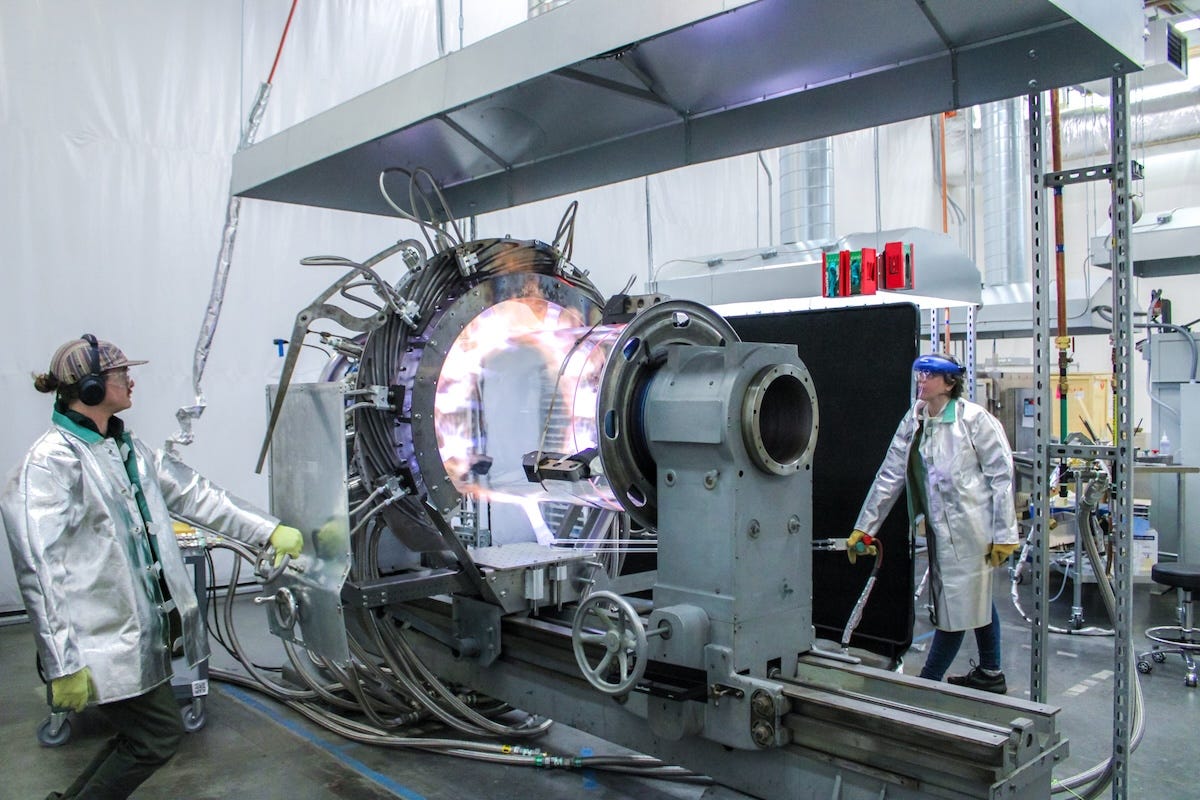
The technology does not appear to be anywhere near completion, let alone being able to provide grid energy by 2028 as Helion has promised, a worrying prospect for the company which will face financial sanctions if they fail to live up to the commercial promises made to Microsoft. Less worrying when one considers that Microsoft is intimately tied up with OpenAI as its largest investor, and the capacity for Microsoft to commit to decarbonisation through Helion’s promises is an elegant regulatory solution. Microsoft wins whether or not Helion provides, and Helion will be propped up by Microsoft and OpenAI regardless. And here is the nature of Western R&D showing its mirror image to the logic of fictitious capital: It doesn’t matter whether objective material results are delivered, so long as the promise is to some extent feasible. Industrialists and scientists can kick the can of development a decade or two down the road, whilst still reaping the ‘rewards’ of meeting a fictitious deadline.
This attitude is coming to bite back at Western power; Artemis III, the successor mission to this year’s captivating manned orbit around the Moon, slated for next year, will involve two commercial experiments with both SpaceX and Blue Origin, to see which company, if any, will be able to deliver the spacecraft necessary to begin the US ambition of setting up a Moon base within the decade. This comes as the US government has pulled funding from NASA in order to increase the military budget, all while rapid inflation (in large part excited by US military action in the Middle East) has forced the agency to cancel its in-house lander programme and delay their overall timeline. NASA have also expressed doubts that either SpaceX or Blue Origin will be able to produce the technology needed within the established timeframe. Jeff Bezos’ Blue Origin has been given special contractual funding by the government to manufacture a ‘competitive market’ in the hope that this will speed up production, but which again comes with no material guarantee and works more as an outsourcing trick than a legitimate solution.
Time is not on NASA’s side, with the CNSA, China’s space agency, hoping to land ‘taikonauts’ on the Moon by 2030 using tried and tested hardware. A delay to the Artemis programme by even a couple years, highly likely in aerospace development, moreso if neither SpaceX or Blue Origin deliver, could see the US lose the initiative in space completely. A Moon base is a vital component of Helion’s need to harvest Helium-3, and thus maintain US momentum in the fusion industry; the old methods of speculation and competition may be costing America the lunar supply chain of the coming decades.
Palantir is a Paper Tiger
Last Saturday, Palantir produced a 22-point summary of their 2025 ‘manifesto’ The Technological Republic by CEO Alex Karp and his firm’s legal counsel Nicholas W. Zamiska. While right-wing tech influence has been building in the US for some time, and the barriers between politics, silicon valley, and high finance have already blurred, this marks the first time a private firm embedded in Western state infrastructure has now openly declared a political programme with allusions to a semi-coherent political philosophical orientation.
The content of Alex Karp’s manifesto presents Palantir as if it were a ‘company of a new type’, a revolutionary force in American society iterating upon various theoretical and political threads left dangling over the last few centuries. The symbolic projection of power and obvious ambition of the document, however, betrays a more squalid reality for the firm; ultimately, the content of the 22-points signals less so a foundational vision for a new American Century, but the pretense of Palantir assuming an equivalent function to the CCP in the United States and its peripheral holdings.
The firm no doubt looks to Chinese Communists with a degree of envy regarding the full spectrum dominance that China’s socialist governance affords. However, Palantir fundamentally lacks the material base to satisfy this desire; Karp calls for a ‘Software-Defined State’ and universal national service which parades as sovereignty, but conceals a desperation of a fictitious dollar hegemon attempting to maintain a sense of historical control.
Of its 22-point summary, a few things leap out as noteworthy. Proposals 1, 4, 5, and 7 argue that Silicon Valley owes a ‘moral debt’ to the US government, a romantic fealty reminiscent of the arguments for industrial fascism in the 1930s; Proposals 21 and 22 explicitly reject notions of pluralism in assertion of a totalising Western supremacy, indeed the supremacy of the technological and military dominance afforded by a credit economy. Proposal 6, perhaps the most radical, calls for a Universal National Service, which would see the entire citizenry militarised and the burden of risk (the currency of a debt economy) spread across the populace.
Against fear-mongering about Palantir’s ‘fascistesque’ output, it’s worth noting that these allusions are themselves part of the firm’s brand ID and marketing strategy. To whatever extent Thiel, Karp, Mosley, etc. actually believe in NRx or fascist politics is hardly relevant; Palantir’s use of controversial allusions serves two primary purposes, the first being the cultivation of an appearance of a collective civilisational mission, something which the Chinese have and the Americans desperately want, and the second being to engender a perverse thrill in both their adherents and detractors. Palantir fascinates because it looks like it might be the ‘American Fascism’ liberal society has been attempting to ward off for almost twenty years now. The style, the approach, everything in Palantir is intended to seduce, and to that end all of their peacockish attitude, NRx blogger prose, and the allusions to class collaboration serve to conceal the fact that Palantir is a paper tiger, incapable by the basic fact that for America to even accomplish one tenth of China’s dirigistic capacity would necessitate such a profound overhaul of their system – one which, if attempted, would likely result in a civilisation-ending civil war, something which would undermine global supply chain stability and therefore not satisfy the balance sheets of Palantir or the Federal Government.
Without indulging too much on Cold War metaphors, this appears to mimic an old Soviet posture: a large-scale power relying on technological and military expenditure at the cost of domestic policy, utilising a culture of extreme surveillance and militarisation of the citizenry to maintain an ideological stranglehold over the state machinery. As workers strike and ‘friction’ builds in reaction to the incapacity of former logics to yield significant returns, the key stakeholders – in this instance manifest in outsourced military surveillance companies – are exposing the extent to which they are willing to maintain social disequilibrium, all in the name of ‘civilisation’ and ‘culture’. The irony is that the Technological Republic is a proposal being made by a company entirely reliant on government contracts.
RMT vs. Labour Intensification

TfL tube drivers took to the picket line this week in response to proposals for a 4-day working week intended as a response to drivers’ demands for shorter working weeks earlier in the year. The RMT, who organised the action, argue that the proposal does not provide for a real reduction in the working day, but only intensifies the hours worked whilst reducing the weekly take-home. Indeed, weekly hours are not being reduced, only the number of days worked, posing a high fatigue risk for drivers opting into the 4-day trial. Furthermore, whilst TfL are proposing the 4-day week as an optional measure, the RMT have rightly identified a lack of guarantee that this will remain the case, raising suspicions that, if successful, their ‘4-day week’ will become standard labour practice from then on.
Strike action on the Underground is always immensely unpopular with Londoners, and is usually an easy target for the press to excite anti-union sentiment. Across social media calls have been made from the public for the full automation of London’s Underground network, not in any drive for greater efficiency or speed, but merely to take the network out of the union’s hands. However, this does not solve the problems raised by the RMT. The safety risks of 'Driver Only Operation' (DOO) are visible on the Thameslink and London Underground networks, and a further reduction in driving staff, coupled with a reduction in Transport Police presence, will render the tube one of the most dangerous places in the city.
The bottom line, however, is that automation cannot solve the issues endemic to the operations of these these networks under the present ownership and management structure. Despite nationalisation, the regulation of these companies will remain relatively unchanged, and operate on the exact same 'for-profit’ mechanism that is presently being pushed to its limit. The corporate push for labour intensification by way of staff reductions and shift compression is a symptom of rapidly declining profitability and the need to exert pressure on the labour component in order to maintain the capital component. Automation may temporarily relieve some of the pressure for these quangos, but the inexorable decline in profits – shown in last week’s Index to be constantly present – will continue to hit hard at the transport industry, with the result being a less safe and less efficient network, reliant on outsourcing and overwhelmed by delays (a familiar story, it would seem).
Palantir and Western governments will have you believe that we are in the midst of a new race – a space race, a weapons race, a technological race, what-have-you. They will have you believe that China is ‘fast catching up’ and we need not be afraid to use dirty tricks to keep our lead. The reality is that there are two completely different races taking place, much as the half marathon that took place in Beijing this week: a human one, and a robotic one. The West is losing both. As China takes the lead in the vast majority of technological publications and novel developments, Western governments look toward an aggressive, AI/defence/finance panacea. As China paves the way for legislative precedent in the integration of new technologies with the existing and future working class, Western governments punish the labour force to maintain fictional margins. The Chinese era is a present reality, and the question remains to when, not if, a Western Belovezha Accords will find their way onto the desk of the Oval Office.