


The property question has once again taken a determinate position in the discourse of contemporary British politics, with London (unsurprisingly) at its epicenter. Last month saw two significant property protests in London: the National Housing Demonstration and Save Lewisham Shopping Centre’s largest rally so far. Ridley Road Market continues to resist evictions by developer Larochette Real Estate with locals and traders occupying the site and refusing to leave. Across London a new wave of grassroots organisations defending social housing and local community and retail spaces against luxury developments is growing, with coalitions such as the 35% Campaign, Refurbish Don’t Demolish, Protect our Places, and SHAPE assuming significant influence in the expression of local political activities throughout the city, alongside targeted local organisations pushing against (re)development schemes across London to ‘Fight the Tower’, ‘Save Deptford High Street,’ ‘Save Brick Lane’, and so on.
Amidst the rising political forces outside of and antagonistic to the Labour Party, struggles for rent controls and public-led planning are returning to the fore. What these movements recognise, and what politicians both local and national continue to obscure, is that London’s model of ‘development’ is neither economically necessary, nor particularly productive in real terms. A growing political constituency now suspects the plans and projections for London’s future to be motivated by cynicism, the prioritisation of value extraction over social need. We have the £4bn Canada Water development, whose developer British Land said in 2020 that 35% of the housing would be affordable – a number stripped to just 3% without support, then 9% after a bailout from the Mayor of London. Of the 1744 homes being offered in Landsec’s proposals for Lewisham Shopping Centre, just 16 percent are considered ‘affordable’ (that household income does not surpass £75,000), and only ninety-eight homes will be available for social rent – and this may yet change again. A mood persists that whatever the initial claims of a developer might be, the tangible result of their developments will invariably attempt to whittle down their affordable housing quotas to zero. A dozen towers of over 20 storeys have been proposed for Old Kent Road with just 12% affordable housing provision and no commitment on the number of new council homes, displacing locals to make way for more extractive, debt-based student housing. Meanwhile, 164,040 UK children were homeless with their families in temporary accommodation in 2024, up 21,650 (15%) since 2023 (Shelter). 1 in 47 people in London are homeless. The social decay engendered by the present development agenda has therefore made the question of property a determinate concern and a significant site for political agitation.
Looking back to the redevelopment of Canary Wharf and the wider Docklands in the 1980s and 90s reveals the precedent for today’s schemes. Local authority power was usurped as large-scale private development was presented as unquestionably beneficial with significant state support. What followed was the suppression and eventual displacement of a local working-class for a transient, alien population of financial, clerical,and managerial workers, with little interest on the part of developers or national government for gradual integration or compromise with the local population. Central in the Docklands development was the Canadian developer Olympia & York, who acquired a vast expanse of derelict dockland in the early 80s amidst the rapid closure of docks and industrial sites. From this initial purchase, an immense office-led development project was proposed, becoming what we know today as Canary Wharf.
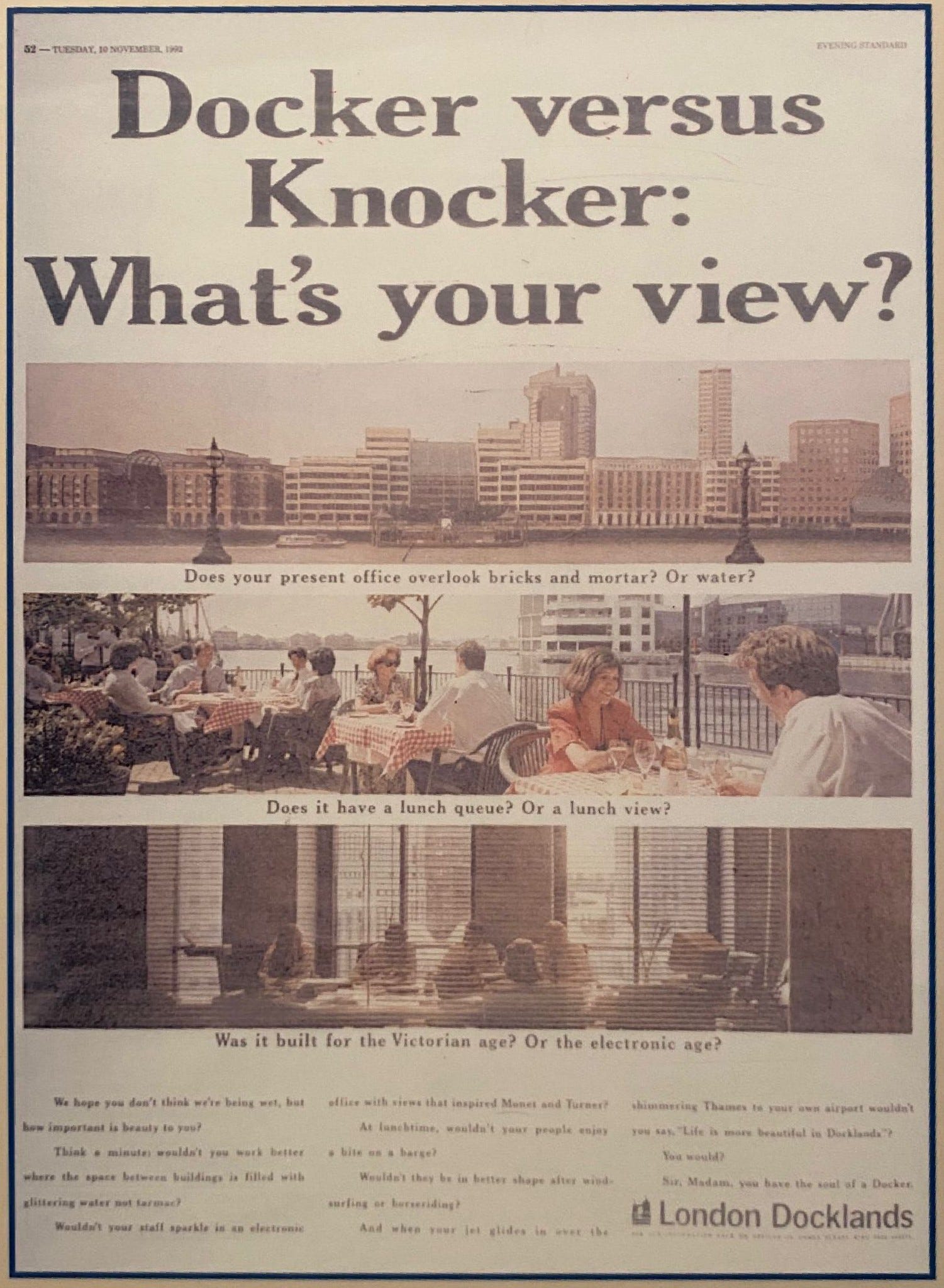
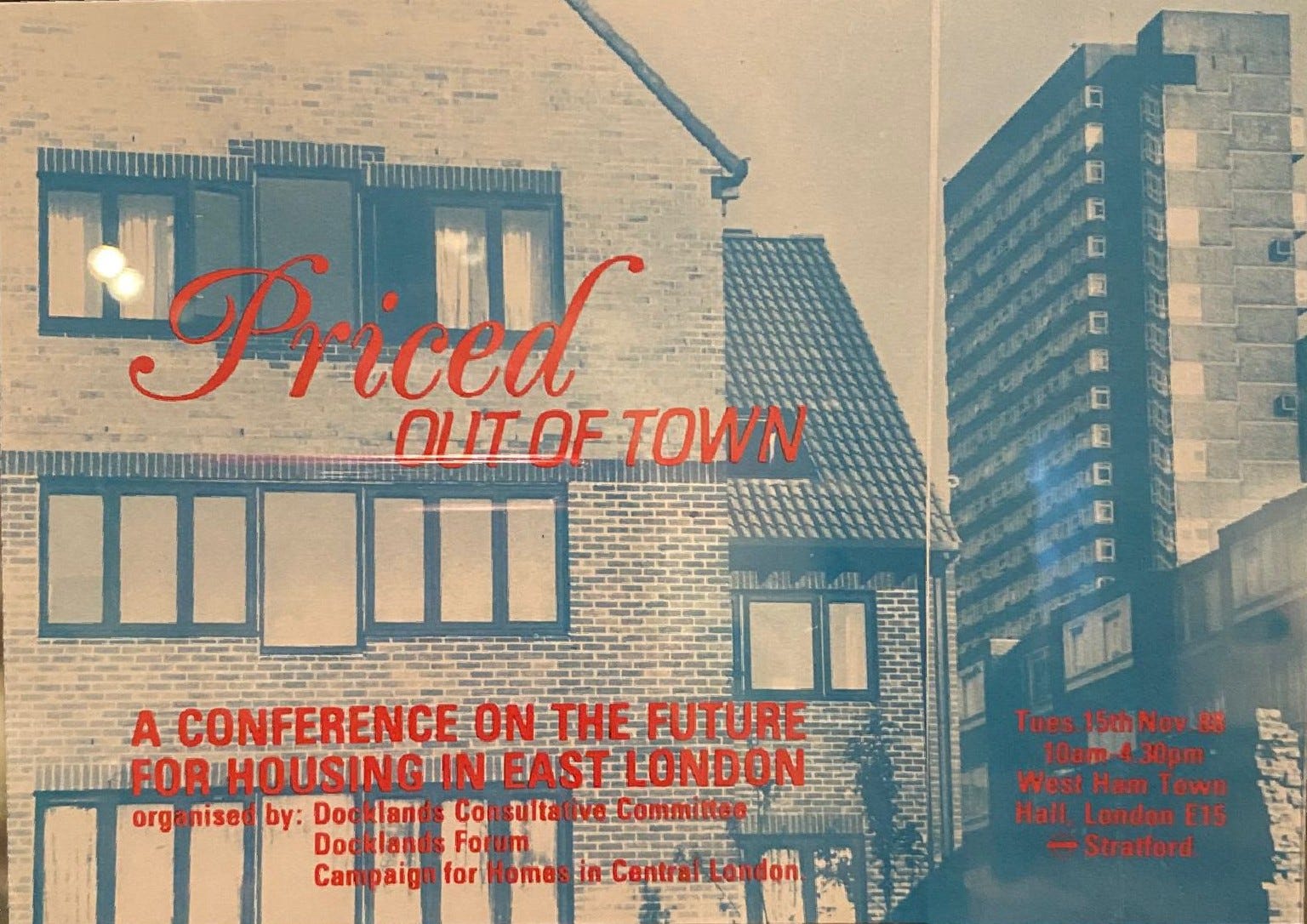
The goal was to build a new business district from scratch to rival the City of London, made possible by the formation of the London Docklands Development Corporation (LDDC) a quanto established by the Thatcher government in 1981 through the Local Government Planning and Land Act 1980. Subject to parliamentary approval, Nigel Broackes was appointed Chairman and Bob Mellish, former Labour MP for Bermondsey, his Deputy. A Board of Trustees, chosen by the Secretary of State, was drawn directly from the private sector. Critically, development authority for Dockland areas would switch from the Boroughs to the new LDDC. By September 1985, 8.5 million sq.ft. of office space had been approved by the LDDC. With concerns that new jobs were incompatible with the existing mode of life and labour of the residents, the Association of Island Communities was established.
The Docklands redevelopment ought to be understood as an experiment in state-directed financialisation, underwriting the construction of a new physical centre for finance capital in rapid time with the expectation of immense future economic growth; the deliverable reality of this was, against expectation, a speculative upswing in land values and investment activity with little in the way of tangible physical benefit to the surrounding area, the foreclosure of all possibility to reopen the docks – historically London’s principle physical economic centre – for the pursuit of abstract speculative returns at an ephemeral future point. Through this process the conception of economic value became detached from physical production, based instead on asset prices and expectations for future returns, with ‘growth’ becoming inexorably tethered to arbitrary speculative asset inflation. The unshakable faith in deregulated finance capital which developed in this period was justified by a shock rise in profitability, strengthening the resolve of the City of London to the point of demanding (from the state) increased capacity for adjacent financial institutions. Expansion into the Isle of Dogs, whose docks had largely been closed in the 1970s and early 1980s, became the most obvious symbolic site for building the model form of a post-industrial London. Ultimately, however, the tendency of the rate of profit to fall reasserted itself, and the fruits of this development now stand as monuments to a fanatical ideological commitment, the fruits of which are readily apparent in the acceleration of social decay, poverty, and nihilism across the de-industrised quarters of the city.

To justify the Docklands developments, towers fit for the ‘electronic age’ and rising land prices were recognised as measures of success, even where employment opportunities were minimal and economic depression persisted. The role of the state in these developments is ubiquitous: Compulsory purchases were a persistent tactic of the LDDC. There are simultaneous efforts to infiltrate, dilute, and maneuver groups to comply. In the case of the Docklands Forum, groups were led to accept funding and eventually capitulate, with community demands relegated to footnotes in the development schemes. In some cases activists were co-opted to act as community liaisons or other intermediaries on behalf of the LDDC directly.
Where these ‘compromise’ measures prove ineffective, developers boldly subvert the democratic institutional process altogether. The GLC and the alternative ‘The People’s Plan for the Royal Docks’ proved problematic for the Docklands developments. As a result, the GLC was abolished outright by Thatcher in 1986. After Southwark Council rejected Berkeley Homes’ proposals for Peckham in July 2025, with the planning committee refusing on the grounds of heritage, affordability, and retail space, Berkeley bypassed the council and appealed directly to the Planning Inspector in a ‘democracy-busting’ move to force the development through. On the local level, councillors like Ted Johns of the East End, or today’s Lewisham Greens, can align and campaign with local groups, but there will always be a higher body aligned with the state’s neoliberal ideology who will wave developments through.
Asset management has become thoroughly embedded in both urban development and housebuilding processes in London. BlackRock owns 10% of shares in the aforementioned Canada Water developer British Land, as well as holding 11% of voting rights in Lewisham Shopping Centre developer Landsec – whose new target borough has “10,986 households on housing waiting lists and 2,800 households living in temporary accommodation” (Faris Luke for Tribune). As of 2021 BlackRock had committed £1.1bn to the UK residential property sector. According to Private Equity Insights: “The UK’s institutional players, such as Aviva, Legal & General, and Lloyds, have been joined by global giants like Blackstone, the world’s largest real estate investor. Since late 2023, Blackstone has acquired 4,500 homes from Vistry in deals totaling £1.4bn. It now oversees 17,000 residential properties in the UK… The surge is driven by rising rental demand and a worsening housing affordability crisis. Investors are shifting their focus toward single-family homes instead of multi-family developments. These properties attract stable, long-term tenants and are simpler to build under the UK’s restrictive planning regulations.”
If the state and the developer are in cahoots over shared economic aims, what form can opposition take? What should opponents aim for, and now should they pursue them?
Some Marxists will consider these developments as broadly positive, given their role in the development of the productive forces and so on, disputing the claims and aspirations of grassroots organisations on account of a perceived moralism; others may see such developments as mere reflections of a further iteration of imperialism, the latest phase in the decline and outsourcing of production to the third world, and therefore feel immobilised, incapable of confronting them by the sheer scale of the forces involved and their own sense of economic irrelevance.
Gentrification is therefore not recognised as something to be ‘resisted’ given that such resistance halts historical transformation, or can't be straightforwardly resolved in a determinate outcome. To oppose Docklands-type development on the grounds that ‘it causes displacement and change, which is sad’ or ‘it is financed by BlackRock, who are nasty’ is to an extent motivated by a conservative or NIMBYist disposition. However, per Marx, ‘progress’ can’t be reduced to the quantitative terms of ‘building more’ or ‘building faster’ – the point of development in a Marxist sense is, on one level, transforming conditions of life in ways that lead to expanded human capacity, reductions in labour time, and tangible qualitative increases in leisure time for the working-class population.
These political pursuits are rendered impossible when workers are displaced, forced to take 60+ minute commutes to work because housing has been made unaffordable, when we still work overtime to afford rent and essentials, when our remaining wages are spent on fleeting self-soothing consumption, when our capacity to focus, converse, and learn is subverted, when healthy food, property, and leisure activities become sparse and inaccessible. Preventing development on terms set by capital is precisely where the power of the working-class lies, averting the futile amnesia of lumpenisation and forging a path of development on terms set by the working-class itself.
A YIMBY impulse persists which accuses anti-gentrification left-wing movements of conservatism. See Leo Gibbons’ comment of 23 April: “The urban Left is overwhelmingly dominated by socially conservative preservation campaigns… Trying to prevent social housing estate regeneration projects, or town centre redevelopments, or even simple things like high street pedestrianisation (like in Deptford).” For all their ridiculing of the Left, those pro-market urbanists or self-identified ‘anglofuturists’ lack a class analysis, hold to a one-sided view of economic progress, and therefore fail to understand why such movements emerge. Gibbons mistakes these movements for vague cultural heritage schemes with aesthetic or moral resentments, presuming the psychology of a Scrutonesque conservative aggrieved about graffiti on the Tube. Rather, grassroots anti-gentrification movements are principally concerned with the survival, integrity, dignity, and future of the struggling tenant, underpaid worker, or burnt out parent, who all bear the brunt of much-lamented decline through ever-worsening living and working conditions. If such movements are ‘regressive’, so is the push to maintain societal standards or clean streets – which is exactly what groups like Looking For Growth pursue while condemning trade unions in a bid to ‘end decline’.
Small businesses, while not ‘inherently progressive’, can play a stabilising role in communities. Their displacement coincides with rising rents and the consolidation of commercial space by larger firms or chains; their refusal to leave can present issues for landlords desperate to raise rents and developers marketing ‘trendy’ areas. The small business owner or pub manager faced with a pedestrianisation or redevelopment scheme is often the only economic impediment to the terminal decline of high streets by extractive monopolies with no concern for social wellbeing – which invariably leads to alienation and its visible consequences of addiction, homelessness, and mental ill health.
The question is, then, how community action groups can win these battles for our class. Let us begin with a look at the changing class character of the Docklands. The dock labour system had been a geographically concentrated, stable workforce with a strong union culture, though by 1967 Millwall docks closed, and by 1972 the union had fallen to just 6,000 members; by 1980 West India Docks had fully closed and sites became derelict. Collective labour was replaced by a fragmented subcontracting system of construction firms. A news item of July 1986 reported that “Preliminary site works began this week on the £2bn Canary Wharf banking centre in London Docklands. Building work is being carried out by a joint venture comprising Costain, Laing, Mowlem, Taylor Woodrow and Sir Robert McAlpine. Works being carried out include general site clearance, diversion of services, stabilisation of quay walls, site investigations and test borings and the erection of site offices.” Every single one of these firms was later revealed to be a subscriber to an illegal blacklisting service by the Consulting Association, dating back to the 1980s. The blacklist monitored unionised workers so that companies could refuse to hire or sack them, often for raising on-site H&S concerns. By the time Canary Wharf was built, the collective labour power that might have played a part in accommodating the development to the local working-class interest was already shattered.
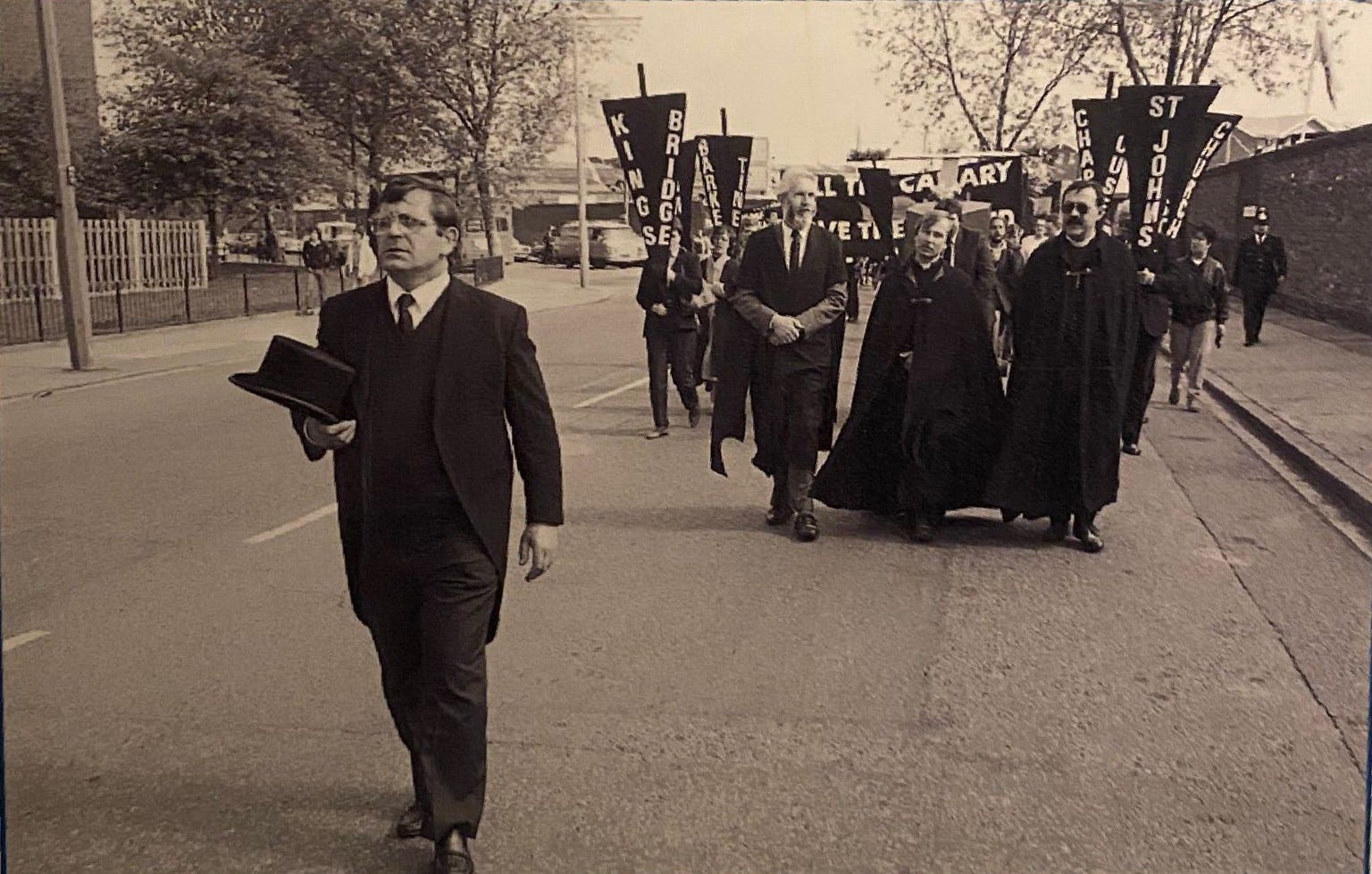
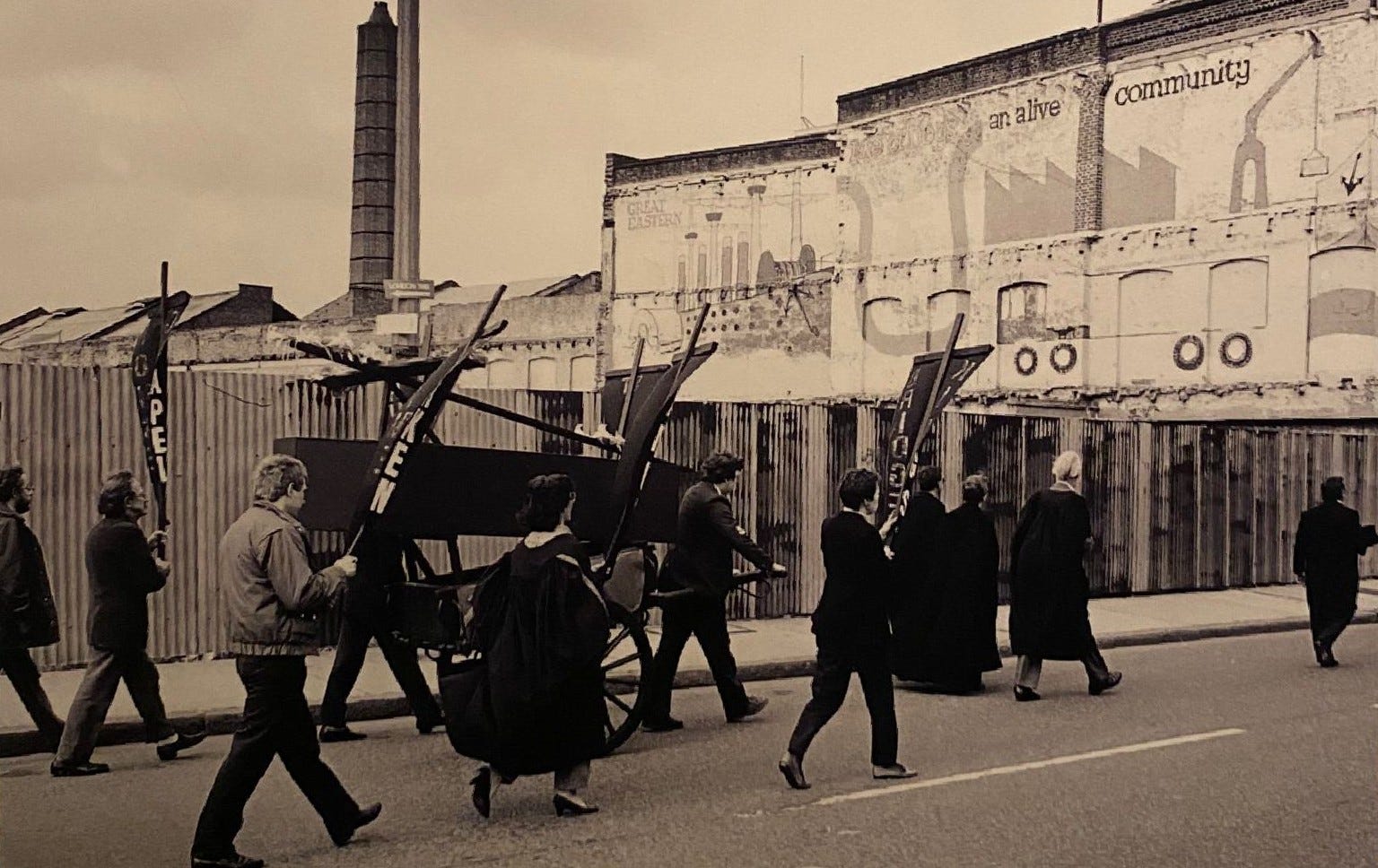
Though the AIC, JDAG and the Docklands Forum had ties with local trade union branches, and many ex-docker families would have taken up other labouring jobs, there is no documented history of communications between these groups and the thousands of labourers hired to construct the new development. There is no documented history of locally-rooted unionisation efforts of these labourers, or their education on what the development meant for local workers. This is not to discredit or minimise the efforts of the Docklands groups. The GLC-supported People’s Plan for the Royal Docks was the product of collaboration between trade unions and tenants’ associations, which combined concerns about underemployment, social housing, and privatisation into a singular set of demands. Its failure was not due to its proponents’ weaknesses; the abolition of the GLC allowed these concerns to be immediately shelved and plans to be rushed through. However, the reorganisation of work into casualised and subcontracted forms left labourers dispersed and functionally scabbing on themselves.
Where workers are fragmented across subcontractors, agencies, and isolated in ‘self-employment’, sectoral amalgamation through industrial unionism creates unified organising power. New Unionism further demonstrates possibilities for unionising the casual or ‘unskilled’ worker and surpass the perceived limits imposed by irregular working hours, immigration and outsourcing. The separation between the people building developments and those displaced by them is intentional. It leads to today’s cultural gulf (and often bitter resentment) between the Reform-voting small-business subcontracted builder and the Green- or Labour- voting unionised worker – both of whom belong in some way to the working-class. Reconnecting labour and community struggles means treating construction sites as part of the same organising terrain as housing campaigns and tenants’ associations. ‘Community unions’ like ACORN and the LRU have demonstrated varying degrees of success in preventing evictions and lobbying negligent landlords. They have acted in solidarity with groups like Save Lewisham Shopping Centre, attending housing protests and the like. However, until community unions and anti-gentrification campaigns are willing to extend their organising beyond defensive struggles into the sphere of production itself, towers will continue to be constructed by a workforce cut off from the communities their employers displace. Where tenants, residents, and workers recognise their shared position within the same process of development, what was once a planning dispute becomes a question of whether the project can proceed at all according to its present terms.
At the same time, anti-gentrification campaigns need to consolidate their demands into a citywide or even national forum, representing localised campaigns at a central level. SHAPE and the Protect our Places coalition are already laying groundwork for wider collaboration by affiliating smaller campaigns. Coalitions can be remarkably effective in providing locals with guidance navigating legal services and strategies to ‘buy out’ developers, such as Asset of Community Value applications, cooperative models and community ownership grants. However, there remain barriers to collaboration as larger street demonstrations dwarf localised, targeted rallies and threaten to overwhelm specific demands with sloganeering and empty rhetoric. Collaboration between campaigns needs to disseminate effective strategies to leading activists so that less time is wasted on Kafkaesque petitions thrown out by councils for formatting reasons, or demonstrations outside empty offices. Our new efforts must learn from both the successes and failures of the past. Otherwise we risk losing our homes to development that thrives on fragmentation, reshaping a city not for those who live and work in it, but for those who take from it and give nothing back.