


By L. Luria
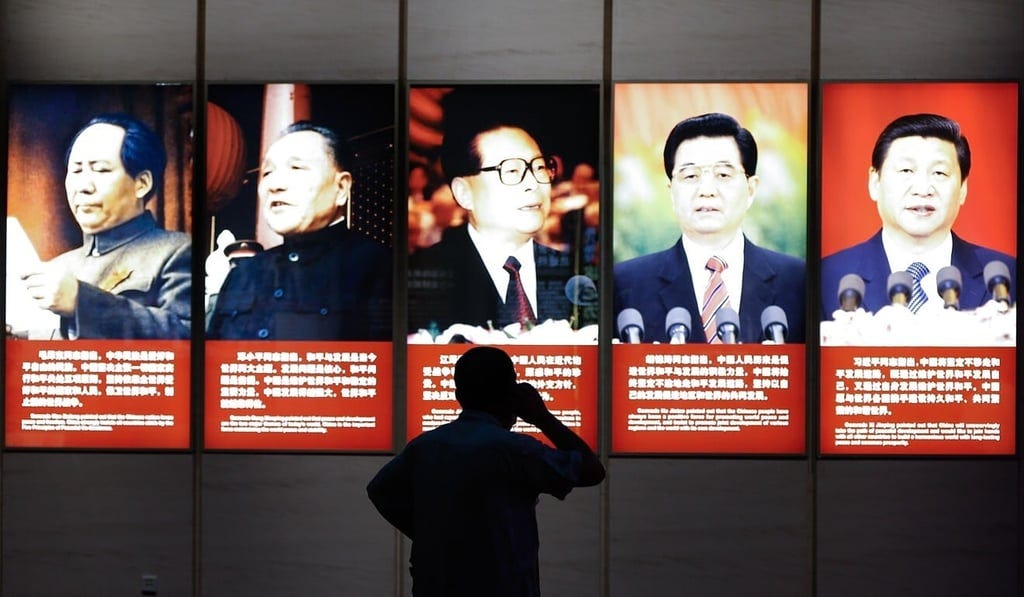
Communists should remain cognisant of the tragedy which persists in our movement. Even our victories are tragic. Lenin’s break with Marxist orthodoxy was tragic; Stalin’s Socialism in One Country, the victory over Trotsky of course, but more so the victory over Bukharin, was brutally tragic; Mao’s break with the Soviet system of planning, the Cultural Revolution, and the geopolitical split were all mired in tragedy; the end of the Cultural Revolution, the transition from Mao to Deng, and then from Deng through Jiang and Hu to Xi, has all been tragic also. I mean that our whole history is tied up in the recognition of necessity, a comprehension that the pursuit of socialism necessitates betrayal and sacrifice, the repudiation of everything which has previously given sense to the project, the ceaseless affirmation of the spirit against the letter, of ruthless criticism at higher and higher degrees of intensity – always more absurd, always more real.
I don't intend this to be read as a romantic eulogy for the prior age of revolutionary optimism; the intent here is simply to elaborate a disposition, beginning with a claim regarding V.M. Glushkov’s project to overhaul the embittered Soviet economic planning regime through the National Automated System for Computation and Information Processing (OGAS). Glushkov’s ambition was to deliver Soviet society to a form of economic organisation wherein money held no necessary determining role in the allocation of goods, overcome through cybernetic planning (in a partial prefiguration of our contemporary data economy1) so as to consciously satisfy the maximal ambition for a society with neither classes nor money. The failure of OGAS represents a permanently lost horizon of communism, that the victorious world-historical ascent of the internet, carrying with it the inherited social logic of its origin in ARPANET, has irreversibly branded the present information age so that the whole of humanity is now inextricably bound in some or another way to the cultural norms and prescriptions of America.
OGAS was an attempt to resolve a persistent anxiety in Soviet communism, the preponderance of bureaucracy and the bureaucratic strata developing within socialist society. The OGAS project aimed in part to solve concerns raised in Josef Stalin's 1928 proclamation that the Soviet Communist Party had yet to root out bureaucratic influence, both in its own ranks and in the ranks of the political, economical, and cultural institutions of the State.
“Bureaucracy is one of the worst enemies of our progress. It exists in all our organisations – Party, YCL, trade-union, and economic. When people talk of bureaucrats, they usually point to the old non-Party officials, who as a rule are depicted in our cartoons as men wearing spectacles. (Laughter.) That is not quite true, comrades. If it were only a question of the old bureaucrats, the fight against bureaucracy would be very easy. The trouble is that it is not a matter of the old bureaucrats. It is a matter of the new bureaucrats, bureaucrats who sympathise with the Soviet Government, and finally, communist bureaucrats. The communist bureaucrat is the most dangerous type of bureaucrat. Why? Because he masks his bureaucracy with the title of Party member. And, unfortunately, we have quite a number of such communist bureaucrats.”
(Speech Delivered at the Eighth Congress of the All-Union Leninist Young Communist League, May 16, 1928)
Despite Stalin’s purported commitment to de-bureaucratisation, concerns that the Soviet bureaucracy was assuming a pernicious role became ever more widespread as his leadership of the Soviet state progressed. The now-preponderant term ‘New Class’, popularised in the West by the adherents of Laschian post-leftism, was given its primary canonical formulation by the dissenting Yugoslav Marxist Milovan Djilas to describe the particular form of the bureaucrat facilitated and nurtured under the Stalin government. The phrase and the thesis are older than Djilas, however; Jan Wacław Machajski at the turn of the last century gave this a more systematic form, arguing that the socialist intelligentsia, the ‘intellectual workers’, constituted a rising new class whose victory through nationalised industry would amount to an eschewing of the emancipation of the proletariat, substituting this ambition for its own accession to power. Leon Trotsky’s attacks on the Stalin government held an equivalence to this line of new class critique albeit differing on a few key areas, condemning the bureaucracy as a ‘caste’ rather than a class, that this strata was not personally enriching themselves by way of surplus value extraction, and so on. Alexander Bogdanov represents another significant Communist engagement with this problem of class and socialist bureaucracy, concerning himself with the distribution of skills and responsibilities within the socialist economic arrangement, positing that the command-execution relation and the monopoly of expertise are themselves proto-class relations; In any case, much of the bitter attitude which defined anti-Soviet Marxism as it developed into the 1930s and 1940s specifically cohered around the unfortunate persistence of bureaucrats, discourse around the class character of this undesirable yet highly embedded social element, and the corresponding perception that Stalin was in some or another way their ‘Bonaparte’, champion of the bureaucrat against than the proletarian.
The concern regarding creeping bureaucratic capture was already present in Marx-Engels’ period, as best expressed in the condemnation of the Marxist purport by the anarchist Mikhail Bakunin: “Either one destroys the State or one must accept the vilest and most fearful lie of our century: the red bureaucracy”. Engels’ attention to the particular point of what form a Socialist government would take is defined (after Saint-Simon) as the supersession of “the government of persons” by “the administration of things,” refusing to elaborate so far as to erroneously prefigure the image of socialism, yet evidently attempting to sketch out something which would annul the fear of a ‘red bureaucracy’ from Bakunin and his ilk. The persistence of this anxiety towards bureaucracy is perhaps then as integral to socialism as revolutionary optimism is; with the movement realising itself in power in 1917, Engels’ formula had been radicalised by Lenin in The State and Revolution, describing political/economic administration as reducible to functions any literate worker could perform; mere “accounting and control”. However, writing shortly after in The Immediate Tasks of the Soviet Government (1918) Lenin pulls the other way and endorses Taylorist scientific management and one-man management, indicating that the actuality of the post-revolutionary state required a level of specialisation, a privileging of certain specialist responsibilities not previously accounted for.

In an address to the Supreme Soviet on 7 May 1957, Khrushchev announced his sovnarkhoz reforms, abolishing the majority of industrial ministries, replacing their authority with numerous regional economic councils (sovnarkhozy) in roughly a hundred economic administrative areas. These reforms were designed in part to decentralise decision-making from all-Union branch ministries to the republics and regions, and to further consolidate Khrushchev’s hegemony, promulgating a perception of systemic change within the bounds of the state, further developing the image of his leadership as a motor for economic renewal and political decentralisation. At the 22nd Party Congress in 1961 Khrushchev announced the Third Programme, stating that Communism would be achieved by the year 1980, a claim which was purportedly guaranteed by scientific calculation and assessment undertaken by senior Soviet economists. The Dictatorship of the Proletariat had given way to the State of the Whole People, announcing the final success of the Khrushchev era in their dismantling of all vestiges of class antagonism. One year after Khrushchev announced the end of class struggle, in early June 1962, a strike at the Novocherkassk Electric Locomotive Works commenced following a nationwide rise in meat and butter prices, coinciding with pay cuts at the plant. Thousands of workers marched on the Party headquarters, met by gunfire from Soviet Army soldiers. Twenty four were killed, with around eighty-seven wounded. Later, seven individuals were executed and over one hundred imprisoned for participation in the strike. The price increases which precipitated the strike were never repeated, the planners instead opting for swelling food subsidies. The same year as the strike, Glushkov’s OGAS was proposed to Soviet authorities, to a mixed reception.
As Glushkov worked on his system amidst criticism and suspicion from the Party elite, the problem of rampant Communist bureaucracy was being dealt with in China by other means: Red Guard cadres directly attacked bureaucrats and figures of seniority in the Party, promoted directly by the Party and the state itself, articulated most succinctly by Mao in his big-character poster Bombard the Headquarters in 1966. That same year, the United States Department of Defence began developing ARPANET, four years after Glushkov first submitted the OGAS project to Soviet officials. In 1969 the first ARPANET computers were connected, and by 1970 had developed into an integrated and expanding network; that year, OGAS was refused funding. The following year, the 24th Party Congress formalised the Soviet Union's commitment to small scale, local, disconnected information exchange systems, shelving OGAS forever.
Had OGAS been implemented, a radical reformation of Soviet bureaucracy would have had to follow. Rather than a reformulation in liberalising terms (as pursued through the Kosygin-Liberman reforms of 1965), OGAS would have given rise to a more profound realisation of the ‘totalitarian’ concept which the less efficient planning regime could only give partial expression to. OGAS would have set the Soviet planning regime onto a path towards ‘completion’, realising the lofty ambition of the depersonalised administration of things. The first phase of this would have necessitated the mass redundancy of the planners, a progressive diminution of the numbers of bureaucrats necessary for the reproduction of Soviet society. In the failure of OGAS and the parallel triumph of ARPANET, the return of capitalism in Russia was made inevitable. By the dismissal of the necessity of a sovereign information exchange system, therefore the Soviet Union’s incapacity to compete in the information age; the cultural forms emerging in America and the broader west during the rise of the nascent information economy became, as Alexei Yurchak words it, ‘sacral objects’ for the Soviet people, holding a resonance and speaking to a profundity which lay elsewhere than their immediate local experience. The period of the 1970s through to the early 1990s was defined by an ever-rising perception within the Soviet Union that their society was in some or another way fraudulent, a tendency which rose concurrently with the development of a form of world economy increasingly determined by electronic information exchange to which the Soviet Union was physically incapable of sufficient participation or mastery.
To pry open the archaic debate about the class character of bureaucrats, we can say that in their reluctance to implement OGAS, the Soviet bureaucracy post-1970 can very much be categorised as having its own independent class character. This is not to say they’re a ruling class in the narrow sense, as a covert bourgeoisie which could hoard capital and direct it towards self-interested partial ends – things which the socialist state still precluded and criminalised – but instead that the bureaucrats after 1970 acted as a determinate partiality, a strata with its own interests and aspirations at odds with those of the population as a whole. Against Djilas and Bogdanov, it does not suffice to say that monopoly control over the social surplus and the means of its allocation are themselves sufficient to determine what a class is, if allocation is still broadly operating according to the pursuit of a common good and socialist construction rather than private interest. However, by sacrificing socialist construction for the sake of maintaining their social position and perverse vestigial identification with a prior period of the productive revolutionary process, in this decisive moment in 1970, the Soviet bureaucracy was transformed from a stratified element of the wider proletariat into something else. Objectively, as a class-in-itself, the bureaucracy had existed for decades as a potentiality, which is what Stalin, Djilas, and the martyrs of Novocherkassk each reveal in different ways. What occurs in 1970 is its becoming a class-for-itself: in refusing the instrument that would have begun to dissolve it, the bureaucracy acts, consciously and decisively, in defence of its own reproduction and against the construction of socialism. This refusal is the moment the new class knows its interest as its own and chooses it; that act of recognition, and not the bare fact of privilege, completes the passage from strata to class. Twenty-one years after OGAS was shelved, the same bureaucracy that dismissed Glushkov’s proposal went on to formally write the Soviet Union out of existence.
To sufficiently comprehend the monumentality of this foreclosure, what OGAS might have meant, it suffices to merely consider what the internet is, what it’s facilitated. In 1916 Lenin identified how the various forms taken by the different instances of imperialism in the late 19th Century, owing to their British genesis, engendered something we could call an economic ‘Anglofication’ of the European powers, a concession to the origin necessary to enter into open financial competition with Britain. Contemporary states have undergone something equivalent, something of a social and economic ‘Americanisation’ by their entry into the global information economy; What is ‘American’ about the internet is located in the firms, the financial superstructure, the lingua franca, and the proprietary logic of accumulation carried through and affirmed as a necessary precondition of online engagement. Had a wholly different social form oriented against the pursuit of mere accumulation have organised this same material substrate, then the formal and informal preoccupations the internet has engendered globally, the seemingly irreversible ‘Americanisation’ of reality, might have been eschewed in favour of the universalisation of the Soviet idea – a Soviet world-episteme encoding the present age of information economy.2
ARPANET was born from the Pentagon in the 1960s, passed to and moulded by American academia, and then, after the state withdrew in the mid-1990s, relied entirely upon the support of private capital, charged with the revolutionary optimism of a borderless market commons expanding across the globe. The internet resolved in time to become the advertising and data-rent form which the functioning of the whole world relies upon, whereas OGAS was conceived from the first as an instrument of the planning state and was killed by that state’s own administrative strata.
Returning to China, as early as 1956 Mao had broken with the Soviet economic planning template, detailing in On the Ten Major Relationships the endemic faults pertaining to over-centralisation and the privileging of heavy industry over light industry & agriculture, calling for power to be devolved to provinces and localities. The vertically integrated branch-ministry apparatus to which OGAS would have hypothetically brought to completion were consciously fragmented under Mao, reaching a terminal intensity under the Cultural Revolution, turning the masses directly against the bureaucracy and the planning apparatus, cultivating across China a dense patchwork of relatively self-sufficient local units loosely bound to the centre as the sovereign architecture of their socialism. In bypassing the highly complex, tightly interlocking machine which the Soviet economy had developed into, the generations of Communist Party leaders succeeding Mao could “grow out of the plan” at the margins through pursuing township and village enterprises and special economic zones without risking the collapse of the entire apparatus as a result. China connected to the internet in 1994 through state-built and state-planned backbones, all cloistered in the confines of the Golden Shield.
At the 2015 Wuzhen conferences, Xi Jinping outlined the manner by which China would engage within this terrain, committing to Chinese ‘cyber-sovereignty’ against the American vision of a globally integrated open commons. China holds a system of mass information exchange identical to, and operating within, the same system as the Western internet, the only difference being that the Chinese internet is retained under political command rather than surrendered to private capital. At the 19th Party Congress in 2017 wherein Xi proclaimed the dawn of the ‘New Era’ of Chinese socialism, the Party committed to the integration of the internet, big data, and artificial intelligence with physical economy as an explicit national objective; In March 2020 the Central Committee and the State Council classified data as the fifth factor of production, alongside land, labour, capital, and technology, and therefore as a resource to be consciously allocated by the state toward explicitly productive and social ends. The opposition between understanding data as private property to be enclosed and rented versus understanding data as a resource equivalent to water, energy, and other natural monopolies demonstrates that a clear step beyond ‘Americanisation’ has been taken. China has engendered a significantly more adequate reorientation of the state towards the actuality of data understood as social factor with immense potential for consciously-oriented social transformation.
This is by no means what Glushkov could have possibly imagined or wanted from OGAS. In the ever-moving process of the realisation of Communism, while OGAS failed and foreclosed upon any prospect for a pure, non-accumulative, non-bourgeois world information exchange system, the object of OGAS has been, in a certain respect, fulfilled beyond any expectation – fulfilled in part through the logic of accumulation itself, through the sobering, profane, tragic actuality of worldly socialism.
The resemblance to the present data economy is one of infrastructure rather than social form; where OGAS proposed real-time networked coordination in order to consciously and conspicuously abolish money, the data economy deploys an equivalent coordinating capacity to deepen the money relation in the conversion of information into rent. OGAS prefigures the actuality of this apparatus while inverting its function through reproducing the vestigial authority of money in an economic system which has long since surpassed its determinate necessity.
Claims for the neutrality or impartiality of technology, mostly levelled by certain Deleuzo-Guattarian types, run counter to the above on the grounds that technologies – specifically technologies which engender exchange – necessarily dissolve the civilisational codes of their original sites of disclosure, therefore reflect less so the culture of their origin and more so the axiomatic, abstract mode of their structure and empirical effects (for example, the M-C-M' code overwhelming the determinacy of prior intuitive codes of production and enculturation). The semblance of social and cultural importation such as we have called ‘Americanisation’ would, for them, be evidence of a residual reterritorialisation, a social-regulatory exercise which can only serve to anticipate (and thus compound) an inevitable grander deterritorialisation to come. However, given that this process is necessarily born out through the historical development of a given particular ‘territory’, the manner by which this deterritorialisation occurs is necessarily branded in some way by the actual historically-contingent frame of reference belonging to that ‘territory’. Through America the world was delivered to the present condition; methods of overcoming this malaise necessitate engagement on the terrain laid forth by ARPANET/internet.